.webp)
.webp)
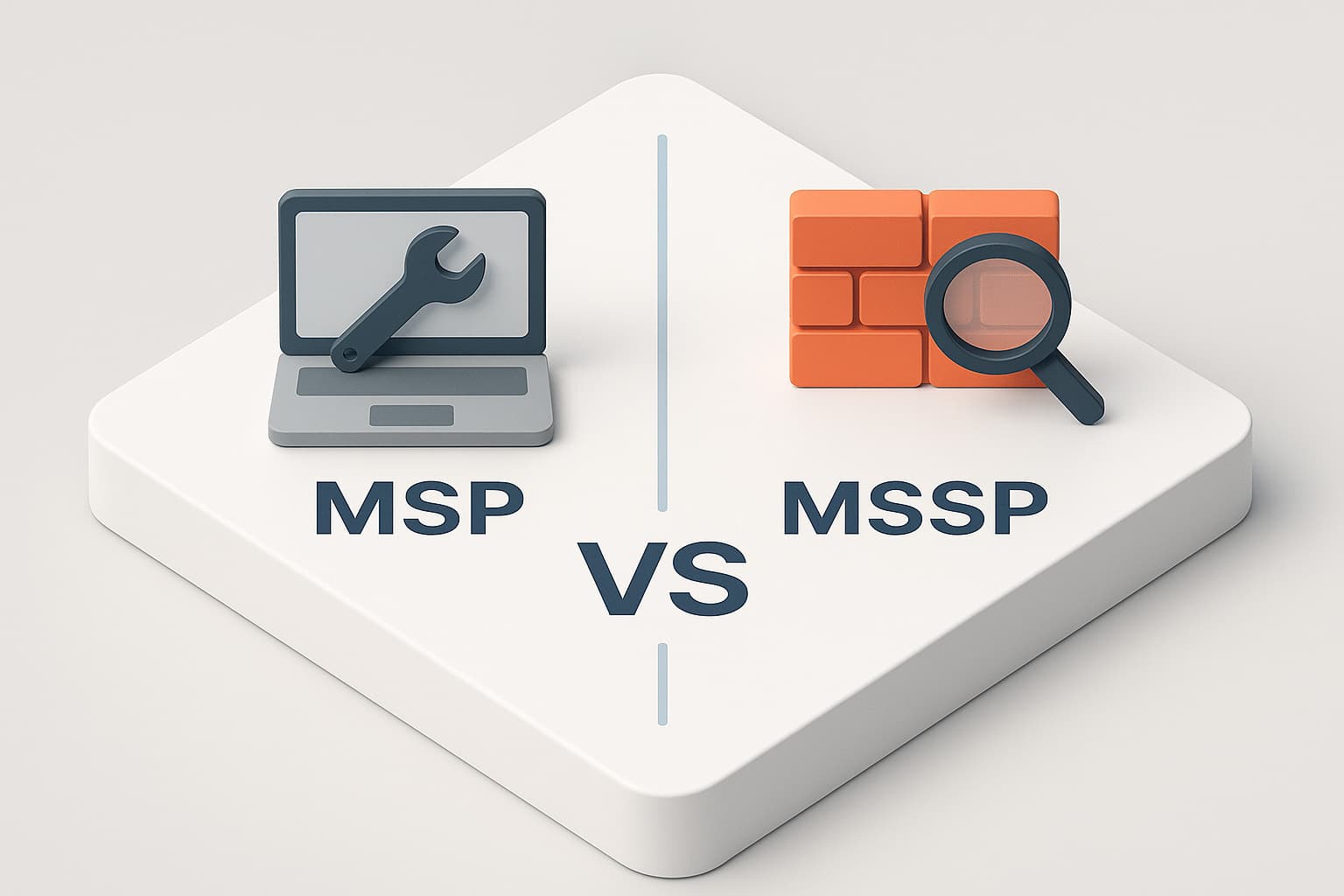
What Is the Difference Between MSP and MSSP for Growing Companies

The difference between an MSP and an MSSP is scope. A managed service provider (MSP) keeps your technology running, working from a Network Operations Center on uptime, help desk tickets, patching, and cloud administration. A managed security service provider (MSSP) protects that technology, working from a Security Operations Center on threat detection, alert investigation, and incident response.
Below we cover what each provider actually does day to day, the tools behind each model, who owns the decisions during a security incident, the five signals that tell a growing company it has outgrown IT support alone, and the questions worth asking before you sign with either.
What Is the Difference Between an MSP and an MSSP?
The key difference between an MSP and an MSSP is what each one is built to watch: an MSP watches whether your systems are working, while an MSSP watches whether your systems are being attacked. Both are outside providers. Both hold deep access to your environment. The similarity ends at the question each one wakes up asking.
Asking different questions produces different staffing, different tools, and different response times. The table below lays out where the two models separate, and the figures it draws on come from the 2026 IBM Cost of a Data Breach Report and the 2026 Verizon Data Breach Investigations Report, both of which we reference throughout this article.
FeatureMSPMSSPPrimary focusIT operations, uptime, productivityThreat detection, response, risk reductionOperations baseNetwork Operations Center (NOC)Security Operations Center (SOC)Core servicesHelp desk, patching, backups, cloud administration, device management24/7 monitoring, alert triage, threat hunting, incident response, compliance evidenceMonitoring typeAvailability and performanceSuspicious behavior and indicators of compromiseResponse expectationBusiness hours ticket queue, after-hours on call for outagesAround the clock analyst coverage with written response timesTypical buyerCompany with little or no internal IT staffCompany with regulated data, contract obligations, or real attack exposure
What Is an MSP Company?
An MSP company is an outside provider that runs your IT operations under a recurring contract, acting as your technology department or as an extension of the one you already have. A technology department handles a predictable set of work: user accounts, laptops and servers, email administration, network equipment, software licensing, backups, and the help desk line people call when something stops working.
Something stops working roughly every day in a growing company, which is why the managed service provider model spread so fast. Research from the Barracuda MSP Customer Insight Report 2025, conducted with Vanson Bourne across 2,000 IT and security decision-makers, found that 73 percent of organizations with up to 2,000 employees already work with an MSP. Working with an outside provider is now the default rather than the exception.
What Does MSP Stand For in Business?
MSP stands for managed service provider in a business technology context. The same three letters carry other meanings elsewhere, including a staffing industry program and the airport code for Minneapolis-Saint Paul, so the surrounding context decides the meaning. Throughout this article, MSP means a company that manages IT infrastructure and support under contract.
What Are the Different Types of MSP?
The different types of MSP separate by how much security work sits inside the contract and how much of your IT the provider owns. Provider ownership varies more than the marketing suggests, and these five shapes cover almost every arrangement a growing company will encounter:
- Break-fix carryover: bills by the hour when something breaks, with no monitoring between calls.
- Pure-play IT MSP: flat monthly fee for help desk, patching, backups, and infrastructure, with antivirus as the security layer.
- Security-forward MSP: adds endpoint detection, email filtering, and security awareness training to the standard IT contract.
- Co-managed MSP: works beside an internal IT person or small team, splitting responsibilities by agreement rather than replacing anyone.
- Integrated MSP and MSSP: runs IT operations and a security function under one contract, with one team accountable for both.
Accountability under one contract is the shape that has grown fastest among companies with compliance obligations, and it is the model we built our own managed services practice around. The other four all leave a question open: what happens when the problem is an attacker rather than a broken printer.
What Is an MSSP Company?
An MSSP company is an outside provider whose entire function is protecting your environment from cyber threats through continuous monitoring, investigation, and response. Investigation is the word that separates an MSSP from a security product. Tools generate alerts by the thousand, and most of those alerts are noise. An MSSP staffs analysts whose job is deciding which alerts are real, how far an intruder has moved, and what has to happen in the next hour.
The next hour matters more than most companies expect. The 2026 IBM Cost of a Data Breach Report puts the mean time to identify and contain a breach at 247 days, 183 days to spot it and another 64 to shut it down, which reversed five straight years of improvement. Breaches that ran longer than 200 days averaged $5.65 million against $4.32 million for those resolved faster. That $1.33 million gap was decided by detection speed rather than by attacker sophistication.
What Is the Difference Between a NOC and a SOC?
The difference between a NOC and a SOC is the signal each room is built to read: a Network Operations Center reads availability and performance, while a Security Operations Center reads behavior. Performance data answers whether a server is healthy, whether storage is filling, and whether a circuit dropped. Health data never answers whether the account that just logged in belongs to the person it claims to belong to.
Account behavior is exactly what a SOC correlates, pulling authentication events, endpoint telemetry, and network monitoring data into one view to separate a normal Tuesday login from a stolen credential. The 2026 Verizon Data Breach Investigations Report found credential abuse present in 39 percent of breaches across the full attack chain, and a stolen credential produces no outage, no ticket, and no alert in a NOC.
What Does an MSSP Do That an MSP Does Not?
An MSSP performs five functions a standard MSP does not: detection engineering, alert triage by human analysts, threat hunting, incident response, and log retention for compliance evidence. Compliance evidence deserves its own mention, because an MSSP keeps the records that prove what happened and when, which is the artifact auditors and insurers ask for after the fact.
After the fact is where most companies discover the gap. Mandiant's M-Trends 2026 research measured a global median attacker dwell time of 14 days, with 52 percent of intrusions detected internally rather than by an outside party. Fourteen days of quiet movement inside a network produces no symptom an IT help desk would ever open a ticket for, which is the practical case for advanced security running alongside IT support rather than inside it.
What Are Common MSP Tools?
Common MSP tools are remote monitoring and management platforms, professional services automation systems, backup and recovery software, device management consoles, and patching engines. Patching engines and backup platforms answer operational questions: is this machine current, is this data recoverable, is this server reachable.
Security questions run on a different stack. An MSSP works with a security information and event management platform, endpoint detection and response agents, threat intelligence feeds, vulnerability data, and case management for alert triage. Each stack answers questions the other cannot, which is why owning one set of tools has never meant covering both jobs.
Covering both jobs is also a staffing question rather than a licensing question. A SIEM with nobody reading it produces expensive logs and no protection, which is the most common shortfall we find when we take over an environment from another provider.
What Is the Difference Between RMM and an MSP?
RMM is a tool, and an MSP is a company. Remote monitoring and management (RMM) software is the platform an MSP installs on your machines to push patches, deploy software, run scripts, and see device health from a central console. An MSP is the provider that operates that platform on your behalf along with everything else in the contract. Buying RMM software without the team behind it leaves you with a console nobody watches.
Can an MSP Also Be an MSSP?
Yes, an MSP can also be an MSSP, but only when security is staffed and operated as its own function rather than bundled in as a product line. A product line means antivirus, a firewall subscription, and a monthly report. A function means analysts on shift, documented detection logic, defined escalation paths, and a written commitment to how fast someone responds at 3 a.m. on a Sunday.
Sunday at 3 a.m. is the honest test of any provider's claim, and it is worth asking directly rather than reading it off a capabilities page. Providers that run both functions well tend to describe the security side in operational terms: who is on shift, what gets escalated, what evidence gets retained. Providers that added the label without the operation tend to describe it in product terms.
Product terms are not a disqualifier for a company whose risk is genuinely low. The mismatch only becomes expensive when a business assumes baseline coverage and active monitoring are the same thing, and finds out otherwise during an incident.
Who Is Responsible When a Security Incident Happens?
Responsibility during a security incident belongs to whoever your contract names, and the most expensive gap in the MSP and MSSP model appears when nobody is named. Nobody being named looks fine on a normal week. It looks very different at 2 a.m. when an alert fires on a finance workstation.
Walk that alert through a two-vendor arrangement. The MSSP sees suspicious activity and calls it. The MSP owns the endpoint management console, so the MSSP cannot isolate the machine without asking. The MSP's on-call technician answers a phone at 2:40 a.m. and needs authorization from someone at your company to disconnect a machine the finance director will need at 8 a.m. Meanwhile the attacker is still moving. Every one of those handoffs is minutes, and minutes turn into the dwell time that drives breach cost.
Breach cost is climbing on exactly this axis. The 2026 IBM report puts the global average at a record $4.99 million, up 12 percent year over year, with the United States average at $11.5 million. The 2026 Verizon report found third-party involvement in 48 percent of breaches, up 60 percent from the prior year, and ransomware present in 48 percent of all breaches analyzed. Deciding in advance who can act, and how fast, belongs in the contract rather than in the middle of the incident, which is why a documented incident response plan is worth writing before you need one.
Who Are MSP Clients?
MSP clients are companies without the internal staff, tooling, or hours to run technology themselves, which today covers most small and mid-sized organizations across nearly every industry. Industry matters less than exposure, and exposure rises faster than headcount. The Barracuda research found reliance climbing steadily with size, from 61 percent of organizations with 50 to 100 employees to 85 percent of those with 1,000 to 2,000.
Size is not what makes a company a target. Verizon's data shows small and mid-sized businesses accounting for roughly 96 percent of ransomware victims where organization size was known, because attackers favor organizations least likely to have someone watching. Around Huntsville, where defense suppliers, manufacturers, and professional firms all sit in supply chains that carry sensitive data, that threshold arrives earlier than headcount alone would predict, and small business cybersecurity stops being optional well before a company feels large.
When Should a Growing Company Move From an MSP to an MSSP?
A growing company should add MSSP-level coverage when any one of five triggers appears, and most companies hit the first one before they notice. Noticing is the hard part, so here are the triggers in the order they usually arrive:
- Regulated or high-value data enters the business. Health records, payment card data, financial files, privileged legal material, or government contract information all carry protection obligations that patching alone does not satisfy.
- A customer sends a security questionnaire. Enterprise buyers and prime contractors now ask about monitoring, logging, and incident response before they sign, and vague answers cost deals.
- Your environment outgrows one person's visibility. More endpoints, more cloud tenants, and more remote workers mean more alerts than any part-time attention can triage.
- You have a near miss. A phishing click that almost worked, a fraudulent invoice caught late, or a vendor breach that touched your data all signal that detection is the gap rather than prevention.
- Your insurer changes the questions. Renewal applications now ask about controls that assume a security operation exists behind them.
Existing behind them is the key phrase, and two of these triggers deserve their own treatment because they are contractual rather than technical. A company that hires an outside team because a customer asked for one has a different problem than a company that hires one because it wants to sleep better, and co-managed IT often becomes the practical bridge when an internal person is already in place.
Can an MSP Handle HIPAA or CMMC Compliance?
An MSP can implement many of the technical controls a framework requires, but frameworks also demand evidence, and producing evidence is security operations work rather than IT work. IT work puts multifactor authentication in place. Evidence work proves it was in place on every in-scope system for the entire assessment period, names the systems inside the boundary, and documents what happens when a control fails.
Failure documentation is exactly what auditors read. A framework such as HIPAA, PCI DSS, NIST SP 800-171, or CMMC expects a system security plan, written policies, retained logs, a remediation plan for open gaps, and a signed affirmation from a company officer. Retained logs in particular have a specific duration attached, and a provider that never configured log retention cannot produce them after the audit notice arrives. Our work on compliance frameworks starts with that evidence trail rather than with tools, because the tools rarely turn out to be the missing piece.
Does Your Cyber Insurance Require an MSSP?
Cyber insurance applications rarely use the word MSSP, and they almost always ask for the controls an MSSP operates. Operated controls now appear as direct yes-or-no questions on renewal forms: multifactor authentication on email and remote access, endpoint detection and response across all endpoints, offline or immutable backups, defined log retention, and 24/7 monitoring with documented escalation.
Escalation is where the answers get uncomfortable. Checking a box for monitoring that runs as automated alerting with nobody on shift creates a gap between what the form says and what the environment does, and that gap surfaces during a claim rather than during underwriting. Answering those questions accurately, and building whatever is missing before the renewal date, is a far better sequence than the reverse.
What Questions Should You Ask a Managed Services Provider?
The questions that separate real coverage from marketing language are operational, and a capable provider answers all of them without hedging. Hedging is itself an answer worth recording:
- Is your Security Operations Center staffed by people, and are those people employees or an outsourced partner?
- What is your written response time for a confirmed security alert at 3 a.m.?
- Who triages alerts after business hours, and what authority do they have to isolate a machine without calling us first?
- What logs do you collect, and how long do you retain them?
- Which security functions do you perform in house, and which do you subcontract?
- What evidence can you produce if our customer or our insurer audits us?
- How do you secure your own access into our environment?
Access into your environment is the question most buyers skip, and it deserves the last word in any evaluation.
Why Your Provider's Own Security Posture Matters
Your provider's security posture becomes part of your risk profile the moment you grant them administrative access to your systems. Administrative access is precisely what attackers want, because compromising one provider reaches every client behind it. The 2021 Kaseya VSA ransomware attack made the arithmetic public when a single compromise of a widely used management platform reached more than 50 providers and an estimated 800 to 1,500 downstream businesses. CISA has since issued joint guidance warning that both criminal and state-sponsored groups deliberately target managed providers as a route into many networks at once.
Many networks at once is also why Verizon's 48 percent third-party involvement figure climbed so sharply. Ask any provider how they enforce multifactor authentication on their own remote access tooling, how client environments are separated from one another, and how they would notify you if their own systems were compromised. A provider that has thought about this answers quickly.
Do You Need Both an MSP and an MSSP?
Most growing companies need both functions, and the real decision is whether to buy them from two providers or from one accountable team. One accountable team removes the handoff problem described earlier, since the people who see the alert are the people who own the console and can act on it. Two providers can work well when responsibilities are documented in writing, escalation paths are tested before an incident, and both sides know who authorizes containment.
Containment authority, response times, and evidence retention are the three details worth settling on paper regardless of which structure you choose. A company with straightforward IT, little regulated data, and a low-value attack surface can run comfortably on a strong MSP whose baseline already includes endpoint detection and email security. A company holding customer data, chasing enterprise contracts, or carrying a framework obligation needs security monitoring that operates as its own discipline.
Frequently Asked Questions
What Is MDR and How Is It Different From an MSSP?
MDR is managed detection and response, a focused service that detects active threats, investigates them, and takes containment action, while an MSSP is the broader category that may include MDR along with vulnerability management, firewall administration, and compliance reporting. MDR leans heavily on analyst-driven response rather than alerting alone. Most companies encounter MDR as one component inside an MSSP relationship rather than as a standalone purchase.
What Is Co-Managed IT?
Co-managed IT is an arrangement where an outside provider works alongside your internal IT staff instead of replacing them, with responsibilities divided by written agreement. A common split gives the internal person user support and business applications while the provider covers infrastructure, patching, security monitoring, and after-hours coverage. Growing companies often use this model when one internal hire can no longer cover everything but a full department is not yet warranted.
Is an MSSP the Same as SOC as a Service?
An MSSP is not the same as SOC as a service, though the two overlap heavily. SOC as a service delivers the monitoring and analyst function specifically, while an MSSP may also handle security tooling administration, vulnerability management, awareness training, and audit support. A company with its own security staff sometimes buys SOC as a service for after-hours coverage while keeping everything else in house.
How Many MSPs Are There in the US?
No authoritative count of US managed service providers exists, since the category has no licensing body or registry. Market size gives a better sense of scale: Grand View Research projects the global managed security services market growing from roughly $42 billion in 2025 to more than $86 billion by 2033. That growth rate outpaces general managed IT services, which reflects how many companies now budget for security monitoring separately.
Can a Small Company Afford Security Monitoring?
A small company can afford security monitoring by scoping it to the systems that actually hold sensitive data rather than applying it everywhere at once. Scoping keeps coverage focused on email, endpoints, identity, and the servers holding regulated records, which is where the 2026 Verizon report shows most attacks landing. Coverage scaled to real exposure costs far less than the alternative, given the IBM finding that faster containment separated $4.32 million outcomes from $5.65 million ones.
Does an MSP Provide Antivirus and Backups?
Yes, nearly every MSP provides antivirus and backups as part of a standard contract, along with patching and email filtering. These are preventive controls, and prevention stops the attacks that rely on known malware and unpatched software. They do not detect an attacker using valid stolen credentials, which the 2026 Verizon report found present in 39 percent of breaches, and that is the coverage line where security monitoring begins.
The Bottom Line
An MSP keeps your technology working and an MSSP keeps it defended, and the two run on different rooms, different tools, and different skills. A growing company almost always starts with the first and reaches a point where the second stops being optional, usually when regulated data arrives, a customer sends a questionnaire, an insurer changes its form, or a near miss makes the gap obvious. None of those moments announce themselves loudly.
Whichever structure you choose, settle three things in writing before you sign: who is watching outside business hours, how fast they commit to responding, and what evidence you can produce when someone asks. Providers who can answer those clearly are the ones worth shortlisting, and the answers matter far more than which label appears on the homepage.
We have supported businesses across Huntsville and the wider Southeast since 2005, running IT operations and security as one accountable function rather than two contracts pointing at each other. If you want a straight read on which coverage your business actually needs today, talk it through with our team or call us at (256) 837-2300. That conversation costs nothing, and it is the work Interweave Technologies has been doing for growing companies for two decades.




.webp)



Share Post