

Interweave Technologies

November 13, 2026

12 min
Do Subcontractors Need to Be CMMC Certified?

Yes, a subcontractor needs CMMC status when it handles Federal Contract Information (FCI) or Controlled Unclassified Information (CUI). Under 32 CFR 170.23, the data sets the level: Level 1 (Self) for FCI and Level 2 at minimum for CUI. The Department of Defense (DoD) acquisition rule in 48 CFR took effect November 10, 2025, and now applies to new solicitations.
Key Takeaways
- CMMC requirements apply to subcontractors at all tiers that handle FCI or CUI in performing the contract.
- FCI-only subcontractors need Level 1 (Self), and CUI subcontractors need Level 2 (Self) at minimum.
- A prime contractor must confirm a current CMMC status at the right level before awarding the subcontract.
- Phase 2 was planned for November 10, 2026. The Department of War suspended it on July 13, 2026.
- Subcontractors that never touch FCI or CUI are outside the CMMC flow-down.
Do Subcontractors Need to Be CMMC Certified?
Yes, subcontractors need to be CMMC certified or self-assessed whenever a subcontract involves FCI or CUI. The status is Level 1 (Self), Level 2 (Self), or Level 2 (C3PAO). The data and the prime contract choose it. Size and revenue do not change the rule.
Only one route produces a true certificate. A Certified Third-Party Assessment Organization (C3PAO) performs that assessment for Level 2 (C3PAO). Self-assessments produce a status that the company posts in the Supplier Performance Risk System (SPRS) instead. The answer to do subcontractors need to be CMMC certified is yes for Level 2 (C3PAO) and self-assessed for other levels.
Suppliers can start with DoD supplier compliance planning that maps each subcontract to a level. That map depends on how the rule treats every tier of the supply chain.
Does CMMC Apply to Subcontractors at Every Tier?
Yes, CMMC applies to subcontractors at every tier that will process, store, or transmit FCI or CUI. Section 170.23(a) of 32 CFR states that compliance is required throughout the supply chain at all tiers. A second-tier or third-tier supplier follows the same data test as a first-tier supplier.
The same section tells primes to comply and to require subcontractors to comply. Primes must also flow down the CMMC requirements to the next tier. Each company in the chain therefore carries its own status. The rule on do subcontractors need cmmc reads the same at every tier.
The rule adds that DoD may give specific flow-down guidance in a solicitation. A subcontractor should read the contract clauses, since the contract text can add detail. The next step is to see what a flow-down is.
What Are CMMC Flow-Down Requirements?
CMMC flow-down requirements are the contract clauses and CMMC levels that a prime contractor must pass to each subcontractor. Clause 252.204-7021 of the Defense Federal Acquisition Regulation Supplement (DFARS) requires the prime to insert its substance in subcontracts. The insertion is required when the subcontract will involve FCI or CUI.
The clause covers subcontracts for commercial products and commercial services. It excludes commercially available off-the-shelf (COTS) items. A supplier of plain COTS goods that never touches FCI or CUI therefore sits outside the flow-down.
The older DFARS 7012 flow down requirements still apply beside CMMC flow down requirements. Paragraph (m) of 252.204-7012 requires primes to include that clause in subcontracts involving covered defense information. Those subcontractors must meet NIST SP 800-171 and report cyber incidents. Reporting duties are a topic for a separate guide, so this post stays on CMMC.
The DFARS 252.204-7020 clause adds a related check. A prime may not award a subcontract subject to NIST SP 800-171 without a Basic Assessment. The subcontractor must have completed it within the last 3 years. The level question comes next.
Which CMMC Level Does a Subcontractor Need?
A subcontractor needs Level 1 (Self) for FCI only, or Level 2 for CUI. The prime contract sets the assessment type. Section 170.23(a) lists four cases. The table below shows each case with the minimum status for the subcontractor.
| Data the subcontractor handles | Prime contract requires | Subcontractor minimum |
|---|---|---|
| FCI only | Any CMMC level | Level 1 (Self) |
| CUI | Level 2 (Self) | Level 2 (Self) |
| CUI | Level 2 (C3PAO) | Level 2 (C3PAO) |
| CUI | Level 3 (DIBCAC) | Level 2 (C3PAO) |
The table shows that a Level 3 prime passes only Level 2 (C3PAO) down as the minimum. The Defense Industrial Base Cybersecurity Assessment Center (DIBCAC) runs Level 3 assessments for the prime. A CUI subcontractor under a Level 3 prime needs Level 2 (C3PAO) at minimum.
Readers who ask what level of CMMC do I need should start from the data, not from the prime's own level. A right CMMC level comes from the subcontract's data flow. The next question is how to tell FCI from CUI.
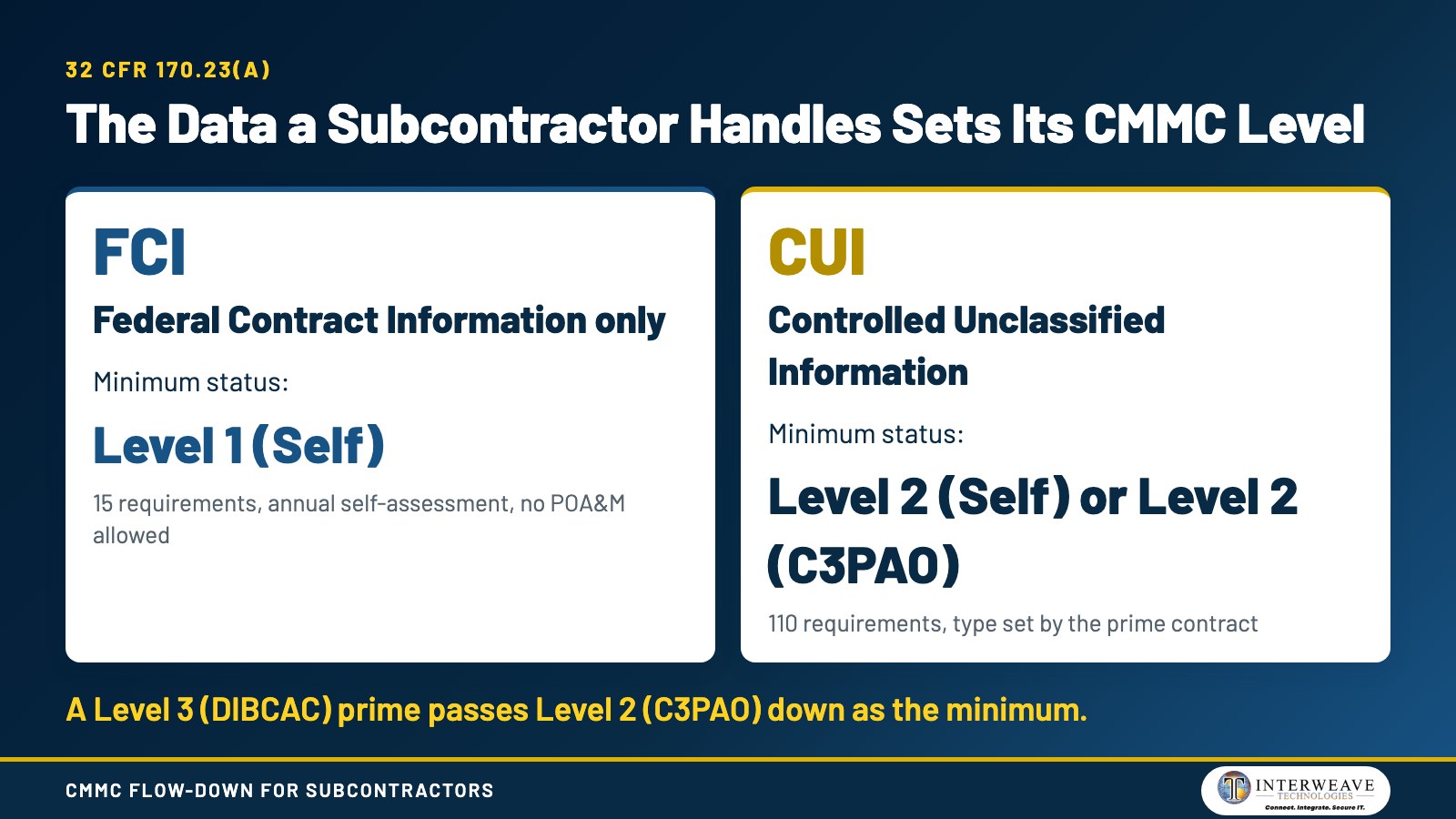
The graphic above shows how the data type routes a subcontractor to its minimum level.
How Do You Know Whether a Subcontract Involves FCI or CUI?
A subcontract involves FCI or CUI when the prime shares or generates contract information that is not public. The Federal Acquisition Regulation (FAR) at 48 CFR 4.1901 defines FCI as information not intended for public release. The information is provided by or generated for the Government under a contract. Public website content and simple payment information are excluded.
CUI is defined in 32 CFR 2002.4(h) and is a separate class from FCI.
The prime contractor identifies the data category, so the subcontractor asks the prime in writing. Useful questions cover whether the work involves CUI, which markings apply, and which level the prime plans to flow down. The answer sets the scope for everything that follows.
What Counts as Handling FCI or CUI?
Handling means processing, storing, or transmitting the information on the subcontractor's systems. Email, file shares, laptops, and cloud storage all count when the data passes through them. An external service provider (ESP) that touches the data brings its own scoping questions under 32 CFR 170.19.
What Are the CMMC Level 1 Requirements for Subcontractors?
The CMMC Level 1 requirements are the 15 basic safeguarding requirements in 48 CFR 52.204-21(b)(1)(i) through (xv). Level 1 applies to subcontractors that handle FCI only. The company completes an annual self-assessment and posts the result in SPRS.
Level 1 allows no Plan of Action and Milestones (POA&M). Every requirement must be met at the time of assessment, according to 32 CFR 170.15. An affirming official at the company also affirms continuous compliance each year.
The clause sets the age limits. A Final Level 1 (Self) status must be not older than 1 year under DFARS 252.204-7021. The affirmation still needs a named company official. Level 2 is a larger step.
What Are the CMMC Level 2 Requirements for Subcontractors?
CMMC Level 2 requires every security requirement in NIST SP 800-171 Revision 2, which is 110 requirements in 14 families. The National Institute of Standards and Technology (NIST) publishes the standard. Section 170.14 of 32 CFR states that Level 2 matches NIST SP 800-171 Rev 2.
The assessment type comes from the prime contract. A Level 2 (Self) subcontractor assesses itself and posts the result in SPRS. A Level 2 (C3PAO) subcontractor undergoes an assessment by a C3PAO. The assessment walkthrough walks through that process in detail.
A subcontractor can reach Conditional status when a POA&M meets the Level 2 rules. The company then has 180 days from the status date to close the open items. DFARS 252.204-7021 limits Conditional status to not older than 180 days. Final Level 2 status must be not older than 3 years, with an annual affirmation.
The scoring math sits in a separate guide on SPRS scores. For this post, the key point is that the status must be current and visible to the prime. The prime's duty comes next.
Does a Prime Contractor Verify Subcontractor CMMC Status?
Yes, a prime contractor must verify subcontractor CMMC status before awarding the subcontract. DFARS 252.204-7021(f)(2) requires the prime to confirm that the subcontractor holds a current CMMC certificate or status at the right level. The check happens before award.
The same clause adds an affirmation duty. Subcontractors and suppliers must complete an affirmation of continuous compliance before award and maintain it each year. The term affirming official is defined in 32 CFR 170.4.
The ordered list below shows five records a prime can request from a subcontractor.
- The CMMC status level and assessment type, such as Level 2 (Self) or Level 2 (C3PAO).
- The status date, so the prime can confirm the age limits in DFARS 252.204-7021.
- The CMMC unique identifier for each system that handles FCI or CUI.
- The annual affirmation of continuous compliance from the affirming official.
- The scope of the assessment, including any external service providers in the environment.
A subcontractor that keeps these five records in one folder can answer a prime in a single message. A status date rules controls when each record expires. Timing therefore decides when the prime asks.
When Do Subcontractors Need to Comply With CMMC?
Subcontractors need to comply once a contract with the clause is awarded. Phase 2 was planned for November 10, 2026. The Department of War suspended it on July 13, 2026, per Crowell & Moring. Section 170.3(e) of 32 CFR sets four phases, each originally starting one calendar year after the last. Phase 1 began on the effective date of the 48 CFR rule, November 10, 2025.
The table below turns the one-calendar-year rule into dates. The dates for Phases 2 through 4 are the originally scheduled dates, calculated from the Phase 1 start. The table covers status as of November 2026.
| Phase | Start date | What DoD intends to require |
|---|---|---|
| Phase 1 | November 10, 2025 (in force) | Level 1 (Self) or Level 2 (Self) in applicable solicitations |
| Phase 2 | Originally November 10, 2026 (suspended July 13, 2026) | Level 2 (C3PAO) as a condition of award, plus Phase 1 items |
| Phase 3 | Originally November 10, 2027 (no date while Phase 2 is suspended) | Level 2 (C3PAO) for all applicable awards and option exercises |
| Phase 4 | Originally November 10, 2028 (no date while Phase 2 is suspended) | Full implementation in all applicable contracts |
DoD may delay Level 2 (C3PAO) to an option period instead of the award. DoD may also require Level 2 (C3PAO) earlier, in Phase 1, for selected contracts. A subcontractor should therefore plan from the prime's contract language and the phase date together.
The prime's flow-down clause controls the date for the subcontractor. A prime can also ask for proof earlier than DoD requires. A CMMC deadlines review helps a supplier set its own timeline.
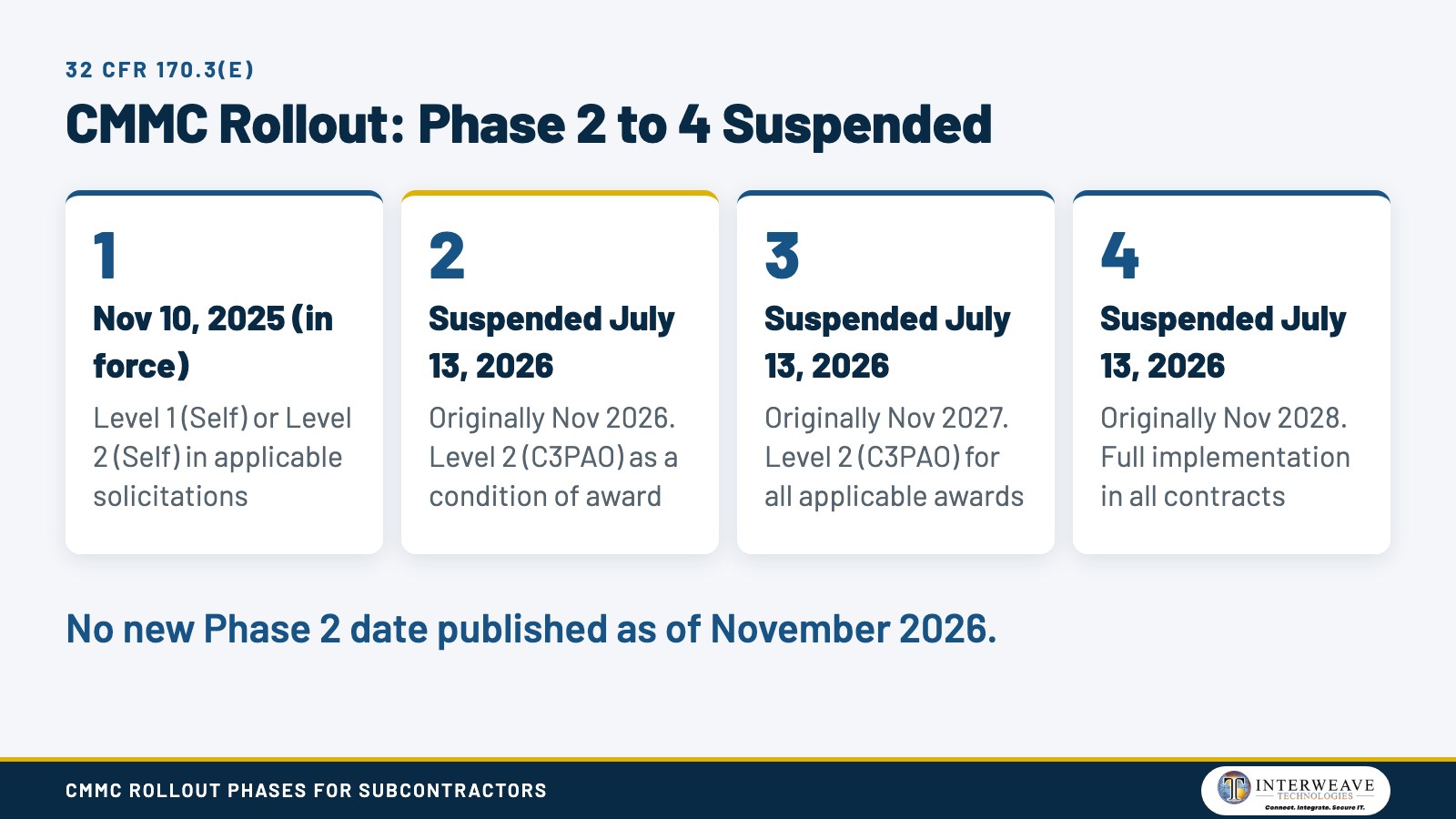
The timeline graphic shows Phase 1 in force and Phases 2 through 4 suspended, with the original start dates.
Who Is Required to Have CMMC Level 2?
The companies required to have CMMC Level 2 are primes and subcontractors that process, store, or transmit CUI. Who is required to have CMMC Level 2 depends on the contract clause and on the data the company handles. The assessment type, self or C3PAO, comes from the prime contract.
A company that reads the term "required" in a solicitation should check three items. The solicitation names the CMMC level, the assessment type, and the phase of award. The CMMC applicability rules apply the same logic to primes.
How Should a Subcontractor Prepare for CMMC Requirements?
A subcontractor should prepare by confirming its data type, scoping its systems, and closing gaps against the right level. The bulleted list below shows five preparation moves for the CMMC requirements for subcontractors.
- Ask the prime in writing whether the work involves FCI or CUI and which level flows down.
- Map where the data lives, including laptops, file shares, email, and external service providers.
- Run a gap review against the 15 Level 1 or 110 Level 2 requirements.
- Write the SSP document, formally the System Security Plan, and a POA&M for open items.
- Collect the status, affirmation, and unique identifier records a prime will request.
The data map shapes the scope, and scope shapes the cost of the assessment. A smaller, well-bounded environment gives the company fewer systems to harden. The CMMC readiness steps expand each move above.
The SSP describes how each requirement is met. Subcontractors that work with a managed provider can share documentation and logs from one place. The grouper below answers common side questions.
What Else Should Subcontractors Know About CMMC?
Does a Subcontractor Without CUI Need CMMC?
Yes, a subcontractor without CUI still needs Level 1 (Self) when it handles FCI. A subcontractor that handles neither FCI nor CUI is outside the flow-down. The prime decides the data category and records it in the subcontract.
Is CMMC Mandatory for Subcontractors?
Yes, CMMC is mandatory for subcontractors when the contract includes the clause and the work involves FCI or CUI. DoD includes the requirement in applicable solicitations as the phases begin. A supplier that handles no FCI or CUI has no CMMC duty on that contract.
Does a Cloud Provider Need to Be CMMC Certified?
An external cloud provider that stores CUI must meet requirements set by the contract. DFARS 252.204-7012 requires a cloud provider to meet the FedRAMP Moderate baseline equivalent. Our guide to the Moderate baseline explains the details.
Can a Subcontractor Use the Prime's Systems Instead?
Whether a subcontractor needs its own status depends on the data path. The 32 CFR 170.23 test applies to FCI or CUI on contractor information systems. A subcontractor should ask the prime to confirm which systems are in scope before relying on prime-provided tools.
Does a Subcontractor Need SPRS Access?
Yes, a subcontractor needs SPRS access to post its CMMC status and annual affirmation. DFARS 252.204-7021 requires the affirmation in SPRS. Level 2 companies also keep a NIST SP 800-171 assessment score current under DFARS 252.204-7019, which a separate guide covers.
Frequently Asked Questions
Who Is Required to Comply With CMMC?
Primes and subcontractors at all tiers that process, store, or transmit FCI or CUI on contractor systems must comply. The status needed is Level 1 for FCI and Level 2 at minimum for CUI.
Does CMMC Apply to Subcontractors Even If the Prime Has Level 3?
Yes. A CUI subcontractor under a Level 3 (DIBCAC) prime needs Level 2 (C3PAO) at minimum. The rule does not flow Level 3 down by itself.
Has CMMC Been Suspended?
Yes, the Department of War suspended CMMC Phase 2 on July 13, 2026, per a Crowell & Moring client alert. No new Phase 2 date exists as of November 2026. Programs may only designate Level 1 (Self) or Level 2 (Self) while the suspension lasts. Existing C3PAO certificates stay valid, and voluntary C3PAO assessments continue. DFARS 252.204-7012 stays in force.
What Is CMMC Replacing?
CMMC adds verification to the existing NIST SP 800-171 duties under DFARS 252.204-7012. Companies that only attested to the standard now post a status, and some undergo a C3PAO assessment.
Do Subcontractors Need CMMC If They Only Supply Off-the-Shelf Products?
No, DFARS 252.204-7021 excludes commercially available off-the-shelf items from the flow-down. A supplier that also handles FCI or CUI for a project should confirm its status with the prime.
How Does Interweave Technologies Help Subcontractors Prepare for CMMC?
Interweave Technologies helps subcontractors prepare for CMMC through a managed compliance program that covers scoping, gap review, documentation, and day-to-day security operations. We are not a C3PAO and do not issue certifications. Our role is to get a company ready for the assessment its prime requires.
A subcontractor can get contract cybersecurity support for the SSP, the POA&M, and the evidence folder that a prime will request. Contractors in North Alabama can start with that support at their own pace.
A short scoping review shows which level a subcontract needs. The review covers data types, systems, and external service providers. Talk to your compliance advisor, attorney, or assessor about contract-specific terms.
Call (256) 837-2300 to discuss defense compliance help for an upcoming bid.
The answer to do subcontractors need to be CMMC certified on a given bid sits in the subcontract data. That data spans clauses, systems, and service providers. The team at Interweave Technologies can walk through that data with you.







Share Post