

Interweave Technologies

November 12, 2026

12 min
How Much Should Managed IT Services Cost for a Small Business?

Managed IT services cost about $100 to $200 per user per month for midsize firms, per a July 30, 2026 provider guide. Kaseya's 2023 survey of 1,091 managed service providers (MSPs) found per-user prices from under $50 to over $250. The question of how much should managed IT services cost comes down to user count, security scope, and compliance needs.
Key Takeaways
- Half of the MSPs in Kaseya's 2023 survey charge $50 to $200 per user per month.
- Per-user, per-device, tiered, a la carte, and flat-fee quotes all exist, so compare the scope before the price.
- Security and compliance tiers raise the per-user rate, as one 2026 provider guide shows with $102, $158, and $210 starting prices.
- One in-house network support specialist earns a median $76,220 per year, before the 30.0% benefits share BLS reports.
- Onboarding, projects, hardware, and licenses sit outside many monthly fees, so ask for each one in writing.
How Much Should Managed IT Services Cost for a Small Business?
A small business should plan on $100 to $200 per user per month for managed IT services. A national managed IT provider published that average in a July 30, 2026 cost guide. The guide ties the figure to services and support levels. A 25-person office at that range pays $2,500 to $5,000 per month.
The same guide lists three plan tiers that start at $102, $158, and $210 per user per month. The $102 tier covers monitoring and support. The $158 tier adds advanced cybersecurity, and the $210 tier adds compliance and disaster recovery. A fully managed IT arrangement lands in the higher tiers because the provider owns more of the work.
Survey data from Kaseya, a software vendor for MSPs, puts those tiers in context. The same data covers managed IT services for small business clients of every size. The next section shows what MSPs charge for the average client each month.
What Is the Average Cost of IT Support for a Small Business?
The average cost of IT support for a small business is $1,001 to $5,000 monthly at 49% of MSPs in Kaseya's survey. Kaseya asked 1,091 MSPs about the average monthly managed service contract per client. Respondents were 83% from the Americas.
The table below shows how those contracts spread across six price bands in 2023.
| Monthly contract size | Share of MSP respondents |
|---|---|
| Up to $1,000 | 22% |
| $1,001 to $2,500 | 26% |
| $2,501 to $5,000 | 23% |
| $5,001 to $7,500 | 11% |
| $7,501 to $10,000 | 4% |
| More than $10,000 | 4% |
Contracts up to $2,500 per month make up 48% of the answers. Contracts above $5,000 make up 19%. The remaining 10% answered not applicable.
A monthly contract is the user count multiplied by a per-user rate, so the per-user price comes next.
How Much Do Managed IT Services Cost Per User?
Managed IT services cost $50 to $200 per user per month for half of the MSPs in Kaseya's 2023 survey. The survey lists 22% at $50 to $100, 17% at $101 to $150, and 11% at $151 to $200. Another 28% do not sell per user managed IT plans.
The infographic below plots the full spread of per-user prices from under $50 to over $250.
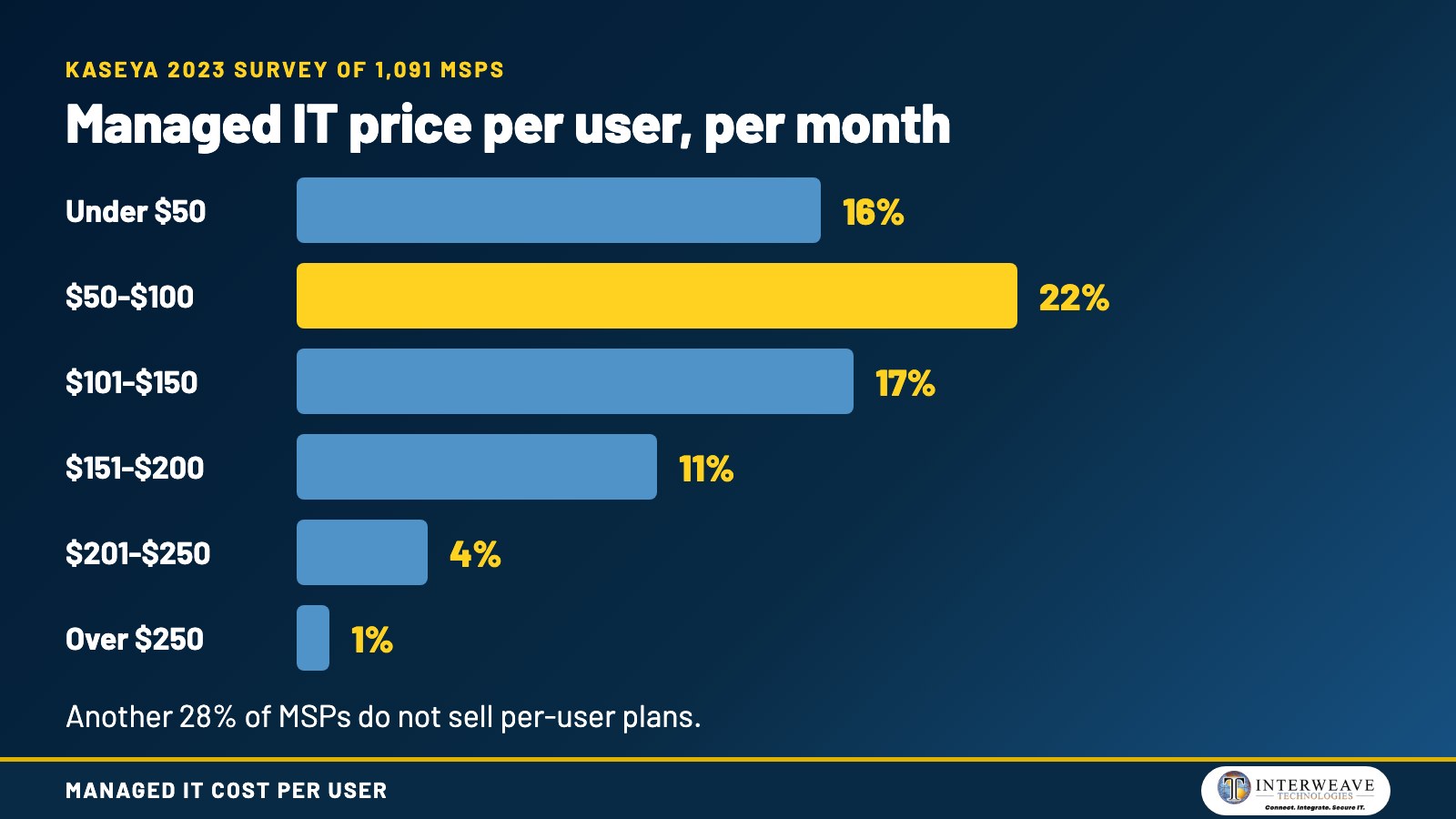
Only 4% of respondents charge $201 to $250, and 1% charge more than $250. Those top bands match the compliance and security tiers in the provider guide. A 10-person office at $101 to $150 pays $1,010 to $1,500 per month, and a 50-person office pays $5,050 to $7,500.
Per-user rates are one of several ways to price the same work, so the models come next.
What Are the Managed IT Services Pricing Models?
Managed IT services pricing models are per user, per device, tiered, a la carte, and flat monthly fee. Kaseya's 2023 survey found more than one-quarter of MSPs combine per-user and per-device billing. More than one-fifth bill per user, and 12% bill a la carte.
Each model charges for a different unit of work, as the list below shows.
- Per user: one monthly rate covers all devices a person uses.
- Per device: each computer, server, or network device carries its own monthly rate.
- Tiered: bronze, silver, or gold bundles set the services included.
- A la carte: the business buys individual services such as backup or monitoring.
- Flat monthly fee: one fixed price covers a defined scope, which Kaseya calls value-based pricing.
Per-device billing fell to 13% of respondents in 2023 from 17% in 2022. The per-device model deserves its own numbers because it changes the math for device-heavy offices.
How Much Does Per-Device Managed IT Pricing Cost?
Per-device managed IT pricing costs $50 to $100 per device per month for 28% of MSPs in Kaseya's 2023 survey. Another 20% charge under $50, and 11% charge $101 to $150. Servers sit in higher bands because they need more administration.
A 20-person office with 35 supported devices at $50 to $100 pays $1,750 to $3,500 per month. The same office on a per-user plan at $101 to $150 pays $2,020 to $3,000. Printers, tablets, and shared PCs push a per-device bill above the per-user bill.
The price per user or device moves with several drivers, which the next section lists.
What Drives the Cost of Managed IT Services?
Managed IT cost is driven by user count, device mix, security scope, compliance needs, and coverage hours. Each driver adds work for the provider, and the provider prices that work into the monthly fee. The list below ranks the drivers by how they change a quote.
- User and device count set the base fee, and servers add more per unit than laptops.
- Security scope covers endpoint detection and response (EDR), email filtering, multi-factor authentication (MFA), and backup testing.
- Compliance needs such as HIPAA or the Cybersecurity Maturity Model Certification (CMMC) add documentation and evidence work.
- Coverage hours separate business-hours help desk from 24/7 monitoring.
- Site count and environment age add travel, cleanup, and replacement work.
Labor cost also shapes the rate. The Bureau of Labor Statistics (BLS) reports a $61,860 median wage for computer user support specialists in May 2025. A provider must cover wages, tools, supervision, and after-hours staff inside the monthly fee.
Coverage hours and tools tie directly to the service list, so the next section covers what the fee buys.
What Do Managed IT Services Include?
Managed IT services include help desk support, device monitoring, patching, backup, and security management for a monthly fee. A provider assigns technicians to each task and reports on tickets and updates. The managed IT explained guide covers each function in detail.
Examples of managed IT services appear in the list below.
- Remote and onsite help desk for employee requests.
- 24/7 monitoring of servers, workstations, and networks.
- Patch management for operating systems and applications.
- Cloud and local backup with restore testing.
- Endpoint security, email security, and MFA setup.
- Vendor coordination for internet, phone, and software providers.
A defined service list also exposes what a quote leaves out, which leads to the extra charges.
What Costs Extra Beyond the Monthly Managed IT Fee?
Costs beyond the monthly fee include onboarding, project work, hardware, and software licenses. A monthly retainer covers keep-it-running tasks. Changes to the environment, such as a new office, a server migration, or a Wi-Fi redesign, carry a separate statement of work.
Hardware and licenses are pass-through costs. Laptops, firewalls, switches, and Microsoft 365 seats bill at the vendor's price, not inside the retainer. Security tools beyond the base plan, such as managed detection and response, may also bill as add-ons.
Ask each provider to list onboarding, projects, hardware, licenses, and add-ons as separate lines. That list also shows whether an in-house hire would cost less, which the next section tests.
Is Managed IT Cheaper Than Hiring an In-House IT Employee?
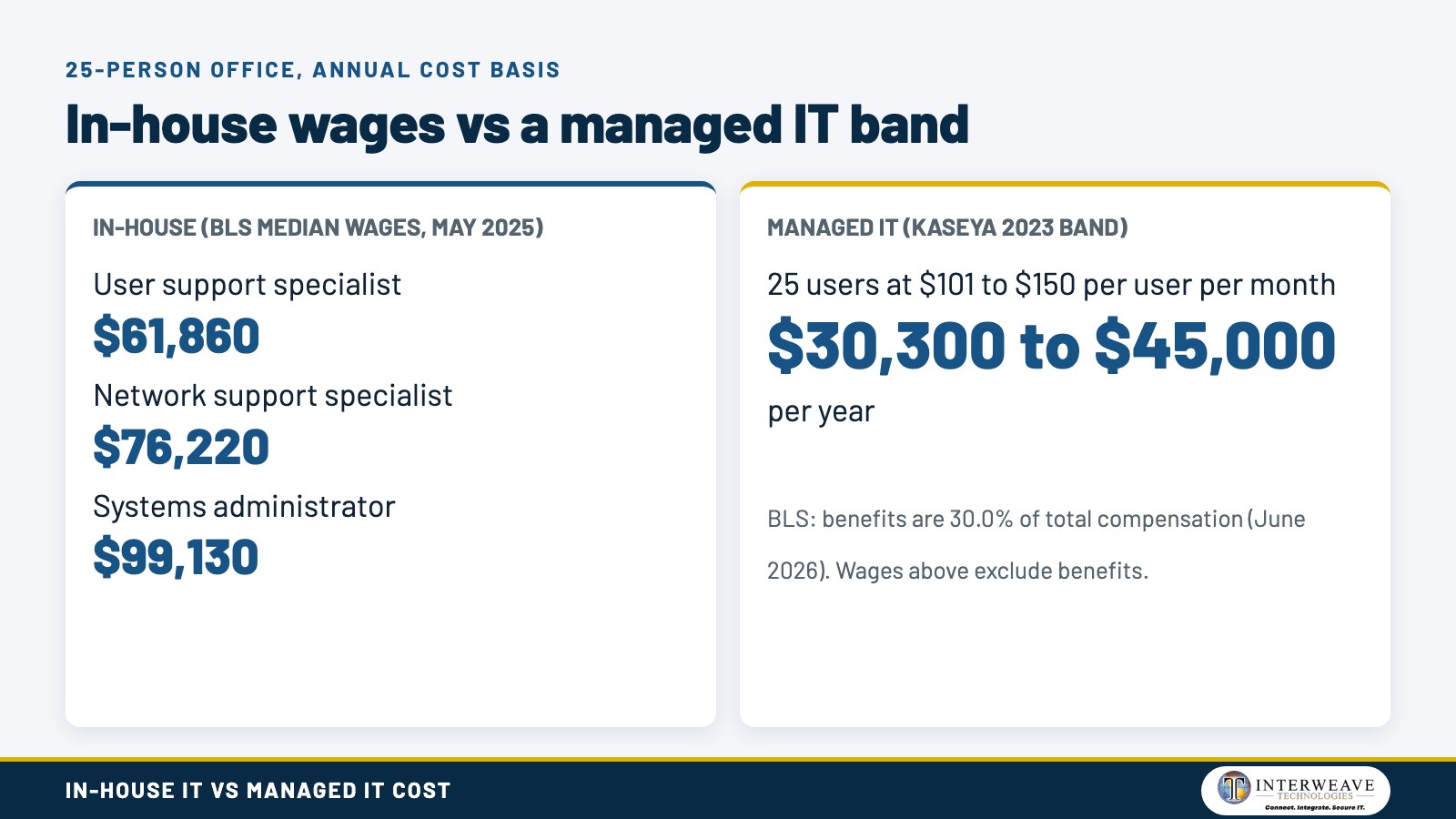
Managed IT is cheaper than one in-house hire for a 25-person office at the $101 to $150 per-user band. That band costs $30,300 to $45,000 per year for 25 users. One median user support specialist earns $61,860 per year in wages alone.
The table below sets the in-house wages from BLS against the managed band from Kaseya's survey.
| Option | Annual cost basis | Source |
|---|---|---|
| Computer user support specialist | $61,860 median wage | BLS, May 2025 |
| Computer network support specialist | $76,220 median wage | BLS, May 2025 |
| Network and computer systems administrator | $99,130 median wage | BLS, May 2025 |
| Managed IT, 25 users at $101 to $150 | $30,300 to $45,000 | Kaseya 2023 survey |
Wages exclude benefits. BLS reports private employers paid $46.89 per hour in total compensation in June 2026, and benefits made up $14.07 of it. That is 30.0% of total compensation.
The figures show cost only, and one employee covers one shift. The infographic below sets the two options side by side.
A business with an IT lead can keep that person and still add outside help, which is the co-managed route.
When Does Co-Managed IT Lower the Bill?
Co-managed IT lowers the bill when an internal IT lead keeps daily tasks and an outside provider covers monitoring, security, and escalations. The provider prices only the gaps. A co-managed model suits firms with one or two IT staff.
Fully outsourced plans cost more per user because the provider owns every task, from the help desk to the firewall. A business with no IT staff pays for that full coverage. Compare the difference between outsourced IT and managed services before choosing a scope.
Scope also decides how much security the fee includes, which moves the price more than any other driver.
How Much Does Security Add to Managed IT Pricing?
Security adds $56 to $108 per user per month in one 2026 provider guide. That moves the starting price from $102 to $158 or $210. The guide describes the $158 tier as adding advanced cybersecurity. The $210 tier adds compliance and disaster recovery.
The cost of skipping security is larger. IBM's 2025 Cost of a Data Breach report puts the global average breach cost at USD 4.44 million. The Federal Bureau of Investigation (FBI) Internet Crime Complaint Center (IC3) recorded $3,046,598,558 in business email compromise losses for 2025.
The Cybersecurity and Infrastructure Security Agency (CISA) states that MFA makes an account 99% less likely to be hacked. CISA also lists offline, encrypted, regularly tested backups among its ransomware practices. The Cyber Readiness Institute summarizes the Verizon 2026 Data Breach Investigations Report. Small organizations made up 96% of ransomware victims.
A provider that bundles EDR and MFA into the plan prices those controls once. A firm with regulated data adds a further layer, covered next.
Does Compliance Make Managed IT More Expensive?
Compliance makes managed IT more expensive because the provider documents controls, collects evidence, and supports audits. A HIPAA practice needs a risk analysis and policies under 45 CFR 164. A defense supplier needs NIST SP 800-171 controls for CMMC.
The added work varies by rule and by how much a firm already has in place. Defense contractors can review contractor compliance support for CMMC and DFARS flow-down rules.
Healthcare offices carry a different set of duties, including the HIPAA Security Rule, which requires a documented risk analysis and written policies. Clinics and billing offices can review medical practice compliance support for those duties.
Talk to a compliance advisor, attorney, or assessor before assuming a managed plan satisfies a rule. Once the scope is clear, a structured comparison of quotes protects the budget.
How Do You Compare Managed IT Quotes?
Compare managed IT quotes by listing users, devices, servers, sites, and coverage hours. Then ask each provider to price the same list. A like-for-like inventory removes guesswork. The steps below turn quotes into a fair comparison.
- Count users, devices, servers, firewalls, Wi-Fi gear, and sites.
- Write down coverage hours and response-time needs.
- List compliance rules that apply, such as HIPAA or CMMC.
- Ask each provider which tools sit inside the monthly fee.
- Request separate lines for onboarding, projects, hardware, and licenses.
- Check contract term, renewal, and exit terms in writing.
The infographic below summarizes the quote checklist as a one-page card.
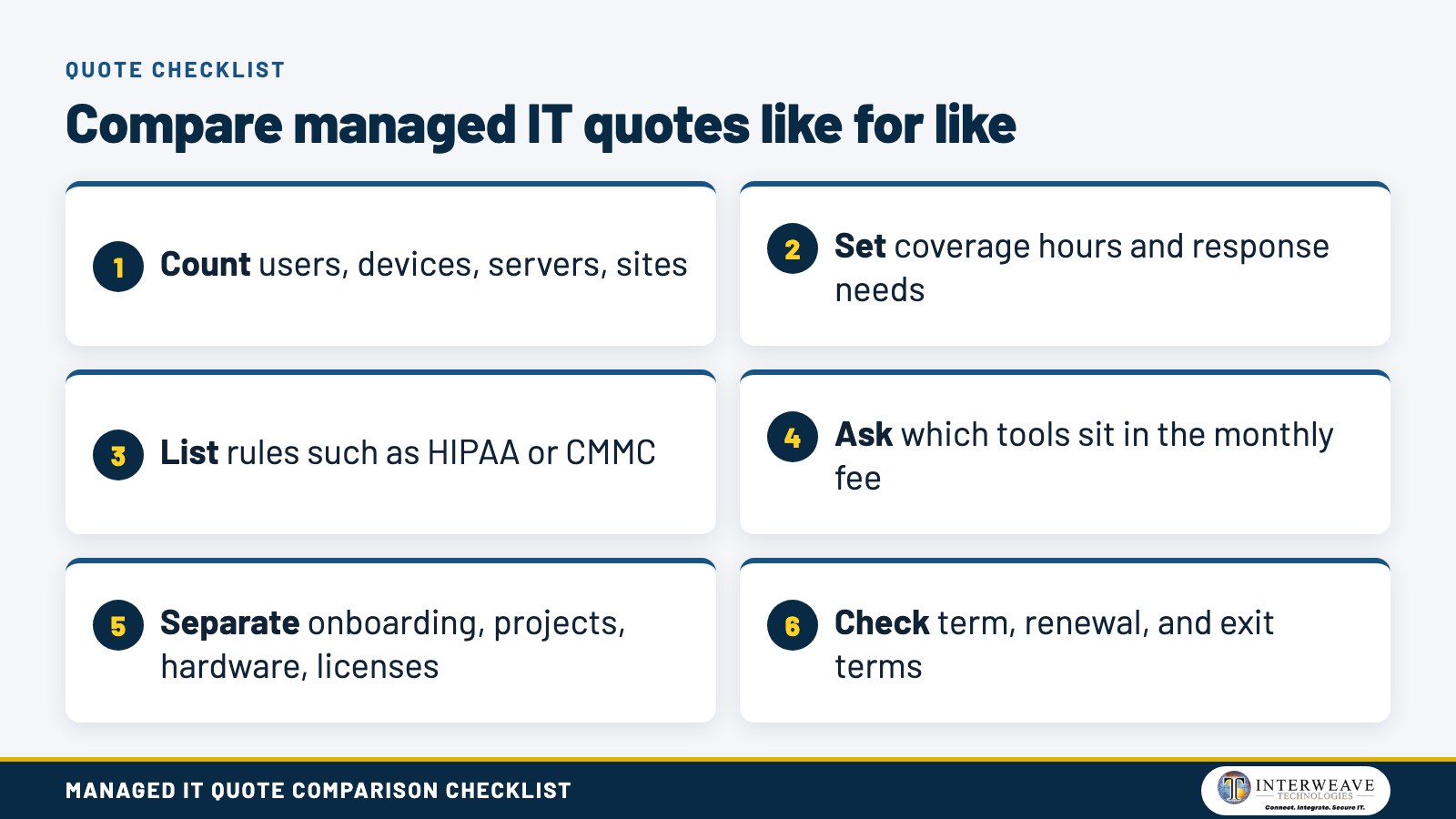
A low quote that skips lines 4 and 5 looks cheaper than it is. Questions about the service itself sit in the next group.
What Else Should You Know About Managed IT Pricing?
What Are Some Examples of Managed IT Services?
Examples of managed IT services include help desk, monitoring, patching, backup, and endpoint security. Each one runs for a monthly fee. A help desk support team handles the daily requests.
What Are the Most Common IT Services?
Kaseya's 2023 survey names cybersecurity, cloud management, infrastructure monitoring, desktop support, and business continuity among the top revenue categories for MSPs. Those categories match the service list above. Backup is part of business continuity, and a backup service sits inside many plans.
What Are Managed Services in Cyber Security?
Managed services in cybersecurity are outsourced security tasks such as endpoint monitoring, email filtering, and incident response. The provider runs the tools and reports on alerts. A virtual CISO adds strategy and policy guidance.
Is a Managed Service Provider Worth the Cost?
A managed service provider is worth the cost when the monthly fee covers work the business cannot staff itself. How much should managed IT services cost depends on the work covered. The in-house table above shows one hire costs more than a 25-user plan in wages alone. Review IT support models to match scope to need.
How Do Contract Terms Change the Cost of Managed IT?
Contract terms change the cost of managed IT through minimum seat counts, term length, and exit fees. Ask each provider for the minimum monthly spend, the renewal date, and the cost of leaving. The managed IT plans a firm compares should state each term in plain language.
Is Break-Fix Support Cheaper Than Managed IT?
Break-fix support bills for each repair, so a quiet month costs little and a server failure costs a lot. Managed IT spreads the cost into a fixed monthly fee and adds monitoring that prevents some failures. Neither BLS nor Kaseya publishes a break-fix price, so the comparison needs written quotes.
Frequently Asked Questions
How Much Does Managed IT Cost for 10 Employees?
A 10-person office pays $1,010 to $1,500 per month at the $101 to $150 per-user band from Kaseya's 2023 survey. At the $50 to $100 band, the same office pays $500 to $1,000. Security and compliance tiers raise the figure.
How Much Does Managed IT Cost for 50 Employees?
A 50-person office pays $5,050 to $7,500 per month at the $101 to $150 band. That total falls in the $5,001 to $7,500 contract band, which 11% of Kaseya respondents reported. Larger offices should request tiered quotes.
Why Do Managed IT Quotes Differ So Much?
Quotes differ because providers include different tools, coverage hours, and support limits. A $102 tier and a $210 tier from the same 2026 guide show the spread. Compare scope line by line before comparing totals.
What Is a Fair Hourly Rate for an IT Technician?
No federal source publishes IT billing rates, because each provider sets its own. BLS reports a $61,860 median annual wage for computer user support specialists in May 2025. A billing rate must also cover benefits, tools, and overhead.
Does the Monthly Fee Include Hardware and Licenses?
Hardware and licenses are separate pass-through costs in many managed plans. Ask the provider whether laptops, firewalls, and Microsoft 365 seats appear as their own lines. Written scope prevents surprises at renewal.
How Does Interweave Technologies Help Small Businesses Plan Managed IT Costs?
Interweave Technologies runs managed IT, cybersecurity, and compliance for businesses in North Alabama and the Southeast. Our team maps users, devices, and risks first, so a quote matches the real scope. A free scoping audit starts that review.
We talk through co-managed and fully managed options with owners and IT leads. How much should managed IT services cost depends on scope, so we price after that review and never in articles. Call (256) 837-2300 to discuss your scope with the Interweave Technologies team.








Share Post