

Interweave Technologies

November 11, 2026

12 min
What Are the Risks of Shadow AI in the Workplace?

The main shadow AI risks are data leakage, compliance violations, security gaps and inaccurate outputs from tools that IT never approved. IBM's 2025 Cost of a Data Breach report found one in five organizations reported a breach due to shadow AI. Those incidents added $670,000 in breach costs on average. This guide covers each risk, plus detection and prevention.
Key Takeaways
- Shadow AI is any AI tool, plug-in or feature that employees use without IT or security approval.
- IBM reports that organizations with high shadow AI paid an average of $670,000 more per breach.
- Pasted prompts can expose customer records, source code, patient data and contract details.
- HIPAA, the FTC Safeguards Rule and DFARS all require control over where regulated data goes.
- Visibility, clear rules and approved tools reduce shadow AI better than a blanket ban.
What Are the Risks of Shadow AI in the Workplace?
The risks of shadow AI in the workplace are data leakage, compliance violations, new security gaps and unreliable outputs. Each risk starts when an employee enters company information into an AI tool that nobody reviewed. IBM found that 97% of organizations with an AI model or application breach lacked AI access controls.
Data leakage comes first. A prompt can carry customer names, financial figures, source code or health information outside the business. Once the text leaves, the company cannot see where the provider stores it or who can read it. Clear AI use rules give staff a line between approved and unapproved tools.
Compliance risk follows leakage. Regulated data sent to a vendor without a contract can break HIPAA, FTC or defense contract duties. Security risk grows next, because AI plug-ins request broad permissions. The last risk is accuracy, since an unchecked AI answer can reach a customer or a filing. The next sections define the term behind these risks.
What Is Shadow AI?
Shadow AI is the use of artificial intelligence tools, models or features without approval from a company's IT and security teams. The term covers public chatbots, browser extensions, AI features inside approved software and homegrown tools built on outside models.
Shadow AI is a subset of shadow IT. Shadow IT means any unapproved hardware or software on a company network. Shadow AI adds one problem: AI tools process, store and may learn from every prompt. A similar concern appears in the personal device rules that businesses already set for phones and laptops. The examples below show how the problem appears day to day.
What Is an Example of Shadow AI?
An example of shadow AI is an employee pasting a customer contract into a free chatbot to summarize it. The contract text leaves company systems, and IT never learns the chat happened. Shadow AI examples appear in every department:
- A sales rep asks a chatbot to polish an email that contains a client's pricing.
- A developer pastes proprietary source code into a public model to find a bug.
- An analyst uploads a spreadsheet of customer records to an AI tool for a summary.
- A manager installs a browser extension that reads every web page the manager opens.
- A clinic employee asks a chatbot to rewrite patient notes.
Palo Alto Networks describes similar cases. One product manager summarized an internal strategy deck, and one developer built a chatbot on customer data. Each case looks routine. A frequent question is whether a well-known tool counts, which the next section answers.
Is ChatGPT Shadow AI?
Yes, ChatGPT is shadow AI when employees use it for work without company approval. The same tool becomes sanctioned AI after the business reviews it and signs the right terms. Rules then limit what data staff may enter.
Approval, not the brand, decides the label. A personal account on any chatbot counts as shadow AI when it handles work data. Verizon's 2025 Data Breach Investigations Report found that 15% of employees routinely accessed generative AI on corporate devices. Of those users, 72% signed in with non-corporate email addresses. The report calls that pattern use outside corporate policy, so the next question is why employees do it.
Why Do Employees Use Shadow AI?
Employees use shadow AI because free tools save time and the approved options are missing or unclear. Microsoft's 2024 Work Trend Index found that 78% of AI users bring their own AI tools to work. The share is 80% at small and medium companies.
Unclear rules add to the habit. The National Cybersecurity Alliance's 2026 Oh, Behave! report found that 43% of workplace AI users say their employer has not clearly explained what is safe to share. The same report found that 32% shared sensitive company information with an AI tool without their employer knowing. A staff member who lacks a rule fills the gap alone, which leads to the security side of the problem.
What Are the Shadow AI Security Risks?
Shadow AI security risks include data exposure, weak account controls, over-permissioned plug-ins and unmonitored data flows. Security teams cannot protect a tool they cannot see, and shadow AI hides inside normal browser traffic.
Account control is one weak point. Verizon found that 17% of the generative AI users it studied signed in with corporate email but without integrated authentication. Without single sign-on and multi-factor authentication (MFA), IT cannot revoke access when an employee leaves. Palo Alto Networks adds that organizations saw an average of 66 generative AI apps. Of those, 10% were classed as high risk.
AI agents add another exposure. An agent built on a no-code tool may hold read and write access to a customer database. Nobody reviews its permissions. Shadow AI threats also include unvetted browser extensions and open-source models downloaded without a source check. A strong DLP controls setup can flag sensitive text before it reaches an outside site. The prompt itself carries the next risk.
What Shouldn't You Tell ChatGPT?
You should not tell ChatGPT or any unapproved AI tool anything that is confidential, regulated or covered by a contract. The tool is a third-party service, and the business has not verified how it stores or reuses inputs. Staff should keep these items out of prompts:
- Customer names, contact details and account numbers.
- Patient information or any other protected health information.
- Source code, passwords, API keys and network diagrams.
- Controlled unclassified information (CUI) or export-controlled technical data.
- Unreleased financial results, pricing and legal strategy.
Anonymized, generic questions carry far less exposure than pasted documents. A rule written in plain words works better than a long policy. The financial side of a leak is the next concern.
What Does Shadow AI Cost a Business?
Shadow AI costs a business an average of $670,000 more per breach when use is high. That figure comes from IBM's 2025 Cost of a Data Breach research. IBM put the global average breach cost at USD 4.44 million and the U.S. average at $10.22 million. The table below shows the shadow AI findings.
| Finding | Figure |
|---|---|
| Organizations reporting a breach due to shadow AI | 1 in 5 |
| Organizations with policies to manage AI or detect shadow AI | 37% |
| Extra breach cost at high shadow AI levels | $670,000 average |
| Shadow AI incidents that exposed personal data | 65% (global average 53%) |
| Shadow AI incidents that exposed intellectual property | 40% (global average 33%) |
The table shows that shadow AI incidents expose more personal data and intellectual property than the average breach. IBM also reported that only 34% of organizations with AI governance policies audit for unsanctioned AI. The graphic below summarizes the headline numbers.
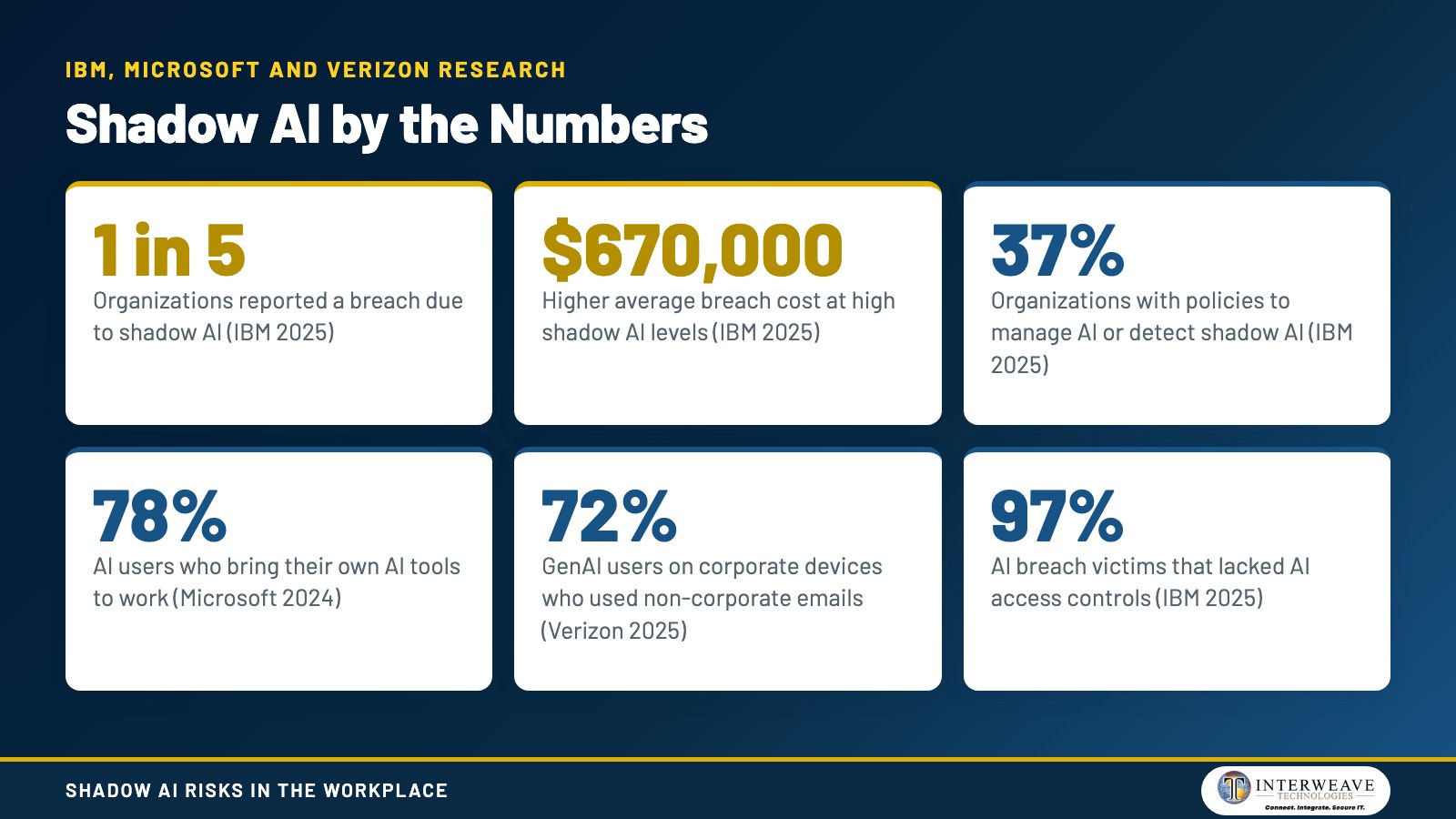
Cost is only part of the exposure. Rules and contracts add legal duties, covered next.
What Are the Compliance Risks of Shadow AI?
The compliance risks of shadow AI are unauthorized disclosure of regulated data to a vendor with no contract. HIPAA, the FTC Safeguards Rule and defense contract rules each require control over where regulated data goes. Talk to your compliance advisor, attorney or assessor about how each rule applies to your business.
For healthcare, 45 CFR 164.308(b) allows a business associate to handle electronic protected health information only with satisfactory assurances. The Security Rule requires a written contract for those assurances. A free chatbot with no business associate agreement (BAA) has no such contract. Providers can review provider HIPAA safeguards before approving any AI vendor.
For financial firms, 16 CFR 314.4(f) of the Federal Trade Commission (FTC) Safeguards Rule requires oversight of service providers. That oversight starts with reasonable steps to select and retain providers that maintain appropriate safeguards. An AI vendor that receives customer information is a service provider.
For defense contractors, DFARS 252.204-7012 sets a cloud rule. An external provider that handles covered defense information must meet the Federal Risk and Authorization Management Program (FedRAMP) Moderate baseline or equivalent. A public chatbot rarely meets that bar. Contractors can study CUI protection rules before staff touch any AI tool. Regulated data is one issue, and the differences from older shadow IT are another.
Why Is Shadow IT Risky, and How Does Shadow AI Differ?
Shadow IT is risky because unapproved software creates data copies and access paths that IT cannot see or secure. Shadow AI carries the same risks plus a new one, because the tool processes the content and may retain it. The table compares the two.
| Factor | Shadow IT | Shadow AI |
|---|---|---|
| What it covers | Any unapproved app, device or service | Unapproved AI tools, models and features |
| Main data risk | Files stored in unmanaged places | Prompts and uploads processed and possibly retained |
| Output risk | Low, since the tool stores data | Higher, since answers may be wrong or biased |
| How it spreads | New app installs or sign-ups | Free chatbots plus AI added inside approved software |
The table shows that AI adds an output-quality risk to the storage risk. Embedded AI also spreads shadow use inside software the company already approved. A risk assessment finds both kinds.
How Do You Run a Shadow AI Risk Assessment?
A shadow AI risk assessment is a five-step review of every AI tool in use. It rates the data each tool touches and sets a decision for each one. The National Institute of Standards and Technology (NIST) AI Risk Management Framework (AI RMF) supports shadow AI risk management. Its four functions are govern, map, measure and manage.
- Inventory every AI tool, extension and embedded feature that staff use.
- Map each tool to the data types that employees enter.
- Rate each tool by data sensitivity, vendor terms and access permissions.
- Decide whether to approve, restrict or block each tool.
- Repeat the review on a schedule and after any new tool request.
NIST AI 100-1, published in January 2023, calls GOVERN a cross-cutting function that runs through the other three. NIST also released a Generative AI Profile on July 26, 2024 as a companion to the framework. A broader AI risk review can fold these steps into the usual cybersecurity assessment. The graphic below shows the flow.
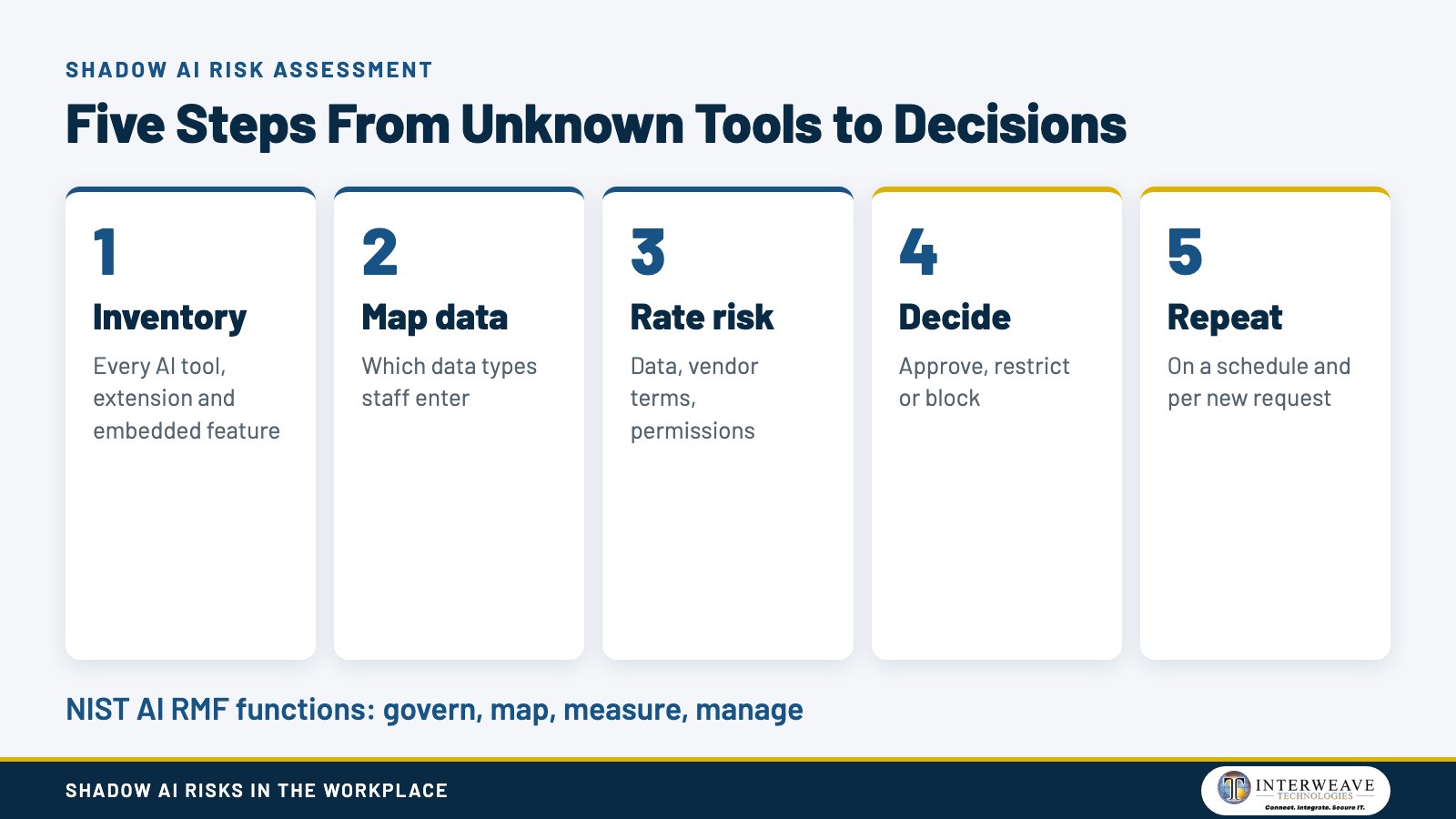
An assessment only works when the inventory is complete, which requires detection.
How to Detect Shadow AI?
Detect shadow AI by combining network and browser monitoring with employee surveys and software reviews. No single method finds every tool, because use spans personal accounts, extensions and embedded features. Five methods work together:
- Review web proxy, firewall and DNS logs for traffic to known AI domains.
- Use a cloud access security broker or browser controls to list AI apps in use.
- Audit browser extensions and third-party app connections to company accounts.
- Check expense reports and software subscriptions for AI purchases.
- Ask staff through a short, non-punitive survey about the tools they use.
Logs gain value when a security information and event management (SIEM) system collects them in one place. A cybersecurity program with 24/7 monitoring turns those logs into alerts. The graphic below compares the detection methods.
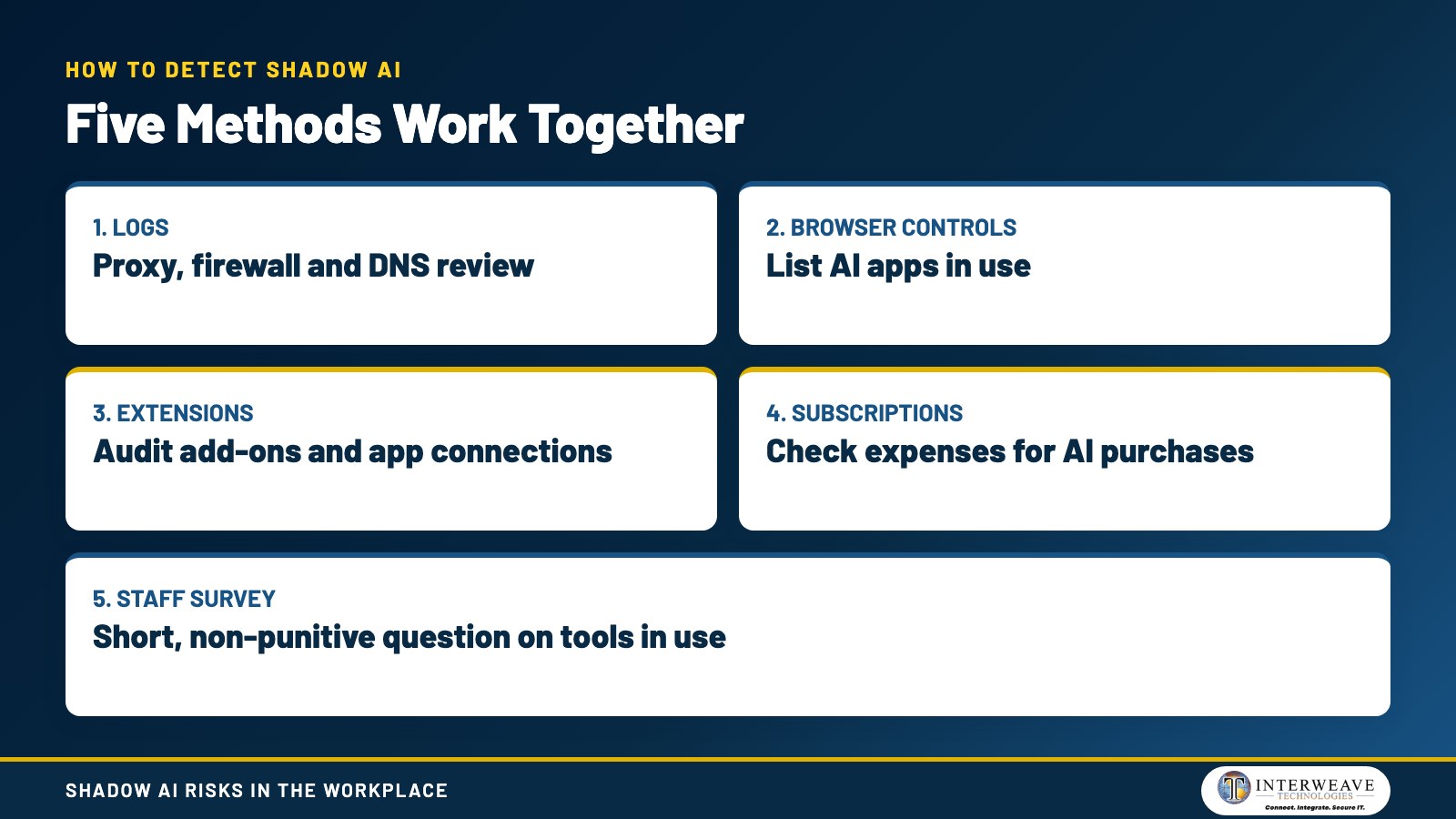
Detection leads to the main question of how to stop the problem.
How to Prevent Shadow AI?
Prevent shadow AI by giving employees approved AI tools, clear data rules and a fast request process. A ban alone pushes use onto personal phones and accounts. Palo Alto Networks recommends visibility first, no blanket bans, role-based allowances and a structured review for new tools.
Start with a short written rule. List the data that never goes into an AI tool. Name the approved tools, and say who to ask about a new one. A formal safe AI use program covers the full policy, so this post keeps the policy brief. Then connect the rule to technical controls.
Technical controls make the rule stick. Single sign-on and MFA tie each AI account to a company identity. Endpoint tools can block unapproved extensions. DLP rules can warn or stop a user who pastes regulated data into a browser. The Cybersecurity and Infrastructure Security Agency (CISA) reports that MFA makes an account 99% less likely to be hacked. Staff still need training to follow the rule.
How to Avoid Shadow AI With Training and Approved Tools?
Avoid shadow AI by training staff on what data stays out of prompts and offering a vetted alternative. Staff turn to outside tools when the approved ones are missing, slow or unknown. Three habits close that gap.
First, teach the rule with real examples from the employee's own job. A short security awareness training session works better than a yearly slide deck. Second, publish a list of approved tools. Third, offer a quick path for a request, so a good idea does not wait months.
Approved tools work best when they fit real workflows. Companies can plan AI strategy planning around the tasks staff already try to automate. Several shorter questions follow, covered next.
What Else Should You Know About Shadow AI?
Is Shadow AI Only a Problem for Large Companies?
No, small businesses face the same exposure with fewer safeguards. Microsoft found the share of AI users who bring their own tools is 80% at small and medium companies. A business with 20 employees can leak customer data through one careless prompt.
Does AI Inside Approved Software Count as Shadow AI?
Yes, a new AI feature inside approved software is shadow AI until the business reviews it. Software vendors add AI features through updates. Each new feature changes where data flows, so a review should follow each release. An AI readiness assessment lists those features alongside data and security gaps.
Why Is Shadow AI Not Permitted?
Shadow AI is not permitted at regulated businesses because it bypasses the controls that protect confidential and regulated data. A company policy sets the rule, and contracts or laws such as HIPAA set the duty. Managers should confirm the exact rule with a compliance advisor.
Should a Business Ban AI Tools?
No, a blanket ban rarely ends AI use. Employees move to personal devices, where IT has no view at all. A better plan approves safe tools, blocks risky ones and trains staff to follow the data rules.
Who Owns Shadow AI Risk Inside a Company?
Leadership owns the decision, and IT or security runs the controls. Legal or compliance staff review vendor terms. A named owner for AI approvals keeps requests moving. A AI risk inquiry can help leaders see where to start.
Frequently Asked Questions
What Does Shadow AI Do?
Shadow AI processes company data in tools that IT has not approved. It can summarize documents, write code or draft messages while the data leaves company control. The business gets speed and loses visibility.
Is Shadow AI Illegal?
Shadow AI is not illegal by itself, but it can cause a violation. Entering regulated data into a tool without a required contract can breach a rule such as HIPAA. Ask an attorney about your specific case.
Can Shadow AI Cause a Data Breach?
Yes, shadow AI can cause a data breach. IBM found that one in five organizations reported a breach due to shadow AI. Weak account controls and exposed data in prompts drive the risk.
How Does Interweave Technologies Help Businesses Reduce Shadow AI Risks?
We help businesses find the AI tools in use, set clear rules and give staff approved tools. Interweave Technologies is a managed IT, cybersecurity and compliance provider in Huntsville, Alabama. We pair monitoring and DLP controls with AI readiness reviews, so leaders see the problem before it becomes a breach.
Our Secure AI services cover AI strategy, assistants, automation and governance for North Alabama businesses and government contractors. Call (256) 837-2300 to talk through your shadow AI risks and the next step for your team.






Share Post