

Interweave Technologies

November 19, 2026

11 min
What Is the Difference Between NIST 800-171 and NIST 800-53?

NIST 800-171 vs 800-53 comes down to scope. NIST SP 800-53 is the control catalog for federal systems and sits in 20 families. NIST SP 800-171 is a narrower set that protects Controlled Unclassified Information (CUI) on contractor systems. Revision 2 has 110 requirements in 14 families, and Revision 3 has 97 requirements in 17 families. Defense suppliers meet SP 800-171 through DFARS and CMMC.
Key Takeaways
- SP 800-53 covers federal information systems, and SP 800-171 covers nonfederal systems that handle CUI.
- SP 800-171 Revision 3 starts from the SP 800-53B moderate baseline and removes federal-only controls.
- Revision 2 holds 110 requirements in 14 families, and Revision 3 holds 97 requirements in 17 families.
- The Cybersecurity Maturity Model Certification (CMMC) rule at 32 CFR 170.14 still ties Level 2 to Revision 2.
- Contractors work from SP 800-171, while SP 800-53 reaches them through cloud services and federal system work.
What Is the Difference in NIST 800-171 vs 800-53?
The difference between NIST 800-171 and 800-53 is who each one protects. SP 800-53 is a catalog of security and privacy controls for federal information systems. SP 800-171 sets security requirements for nonfederal systems and organizations that process, store, or transmit CUI.
The two publications share a family tree. SP 800-171 is derived from SP 800-53, so each 800-171 requirement points back to a source control. A defense supplier that needs help reading both documents can start with defense compliance support from a managed provider.
The comparison table later in this post lines up scope, size, families, and legal drivers. First, the next section explains what SP 800-171 is used for.
What Is NIST 800-171 Used For?
NIST 800-171 is used to protect the confidentiality of CUI when that data sits on a nonfederal system. The National Institute of Standards and Technology (NIST) says federal agencies use it in contractual vehicles and other agreements with nonfederal organizations. Contract clauses make the requirements binding.
Defense work is the clearest case. DFARS clause 252.204-7012 says the covered contractor information system is subject to the security requirements in NIST SP 800-171. The Department of Defense (DoD) reaches subcontractors through the same clause.
CUI is government information that needs safeguarding but is not classified. Examples include contract drawings, technical data, and export-controlled files. The next question covers the larger catalog that SP 800-171 grew from.
What Is NIST SP 800-53?
NIST SP 800-53 is a catalog of security and privacy controls for information systems and organizations. NIST Revision 5 organizes the catalog into 20 families. Federal agencies select controls from it based on each system's impact level.
The companion publication SP 800-53B defines three security control baselines, one each for low-impact, moderate-impact, and high-impact systems. A privacy baseline applies to every system regardless of impact. On August 27, 2025, NIST issued Release 5.2.0, a minor update that left the baselines unchanged.
Each family groups controls by topic, so the family list shows how wide the catalog is.
What Are the NIST 800-53 Control Families?
The NIST 800-53 control families number 20. Each family bundles related controls under a two-letter ID. The NIST Revision 5 list runs in alphabetical order by ID.
- AC Access Control.
- AT Awareness and Training.
- AU Audit and Accountability.
- CA Assessment, Authorization, and Monitoring.
- CM Configuration Management.
- CP Contingency Planning.
- IA Identification and Authentication.
- IR Incident Response.
- MA Maintenance.
- MP Media Protection.
- PE Physical and Environmental Protection.
- PL Planning.
- PM Program Management.
- PS Personnel Security.
- PT PII Processing and Transparency.
- RA Risk Assessment.
- SA System and Services Acquisition.
- SC System and Communications Protection.
- SI System and Information Integrity.
- SR Supply Chain Risk Management.
SP 800-171 keeps only part of that list, because NIST removes controls that agencies alone can carry out. The next section shows how many requirements remain.
How Many Controls Does NIST 800-171 Have?
NIST 800-171 Revision 2 has 110 security requirements in 14 families, and Revision 3 has 97 requirements in 17 families. The count depends on the revision. NIST withdrew Revision 2 on May 14, 2024, and published Revision 3 in May 2024.
The Revision 3 total counts active requirements only. NIST marks 33 numbered requirements as withdrawn because it merged them into others. Revision 3 also adds organization-defined parameters, covered in a later section.
The graphic below shows both revisions beside the SP 800-53 family count in the NIST 800-171 vs 800-53 comparison.

A side-by-side table adds scope, audience, and legal drivers to those counts.
How Do NIST 800-171 and 800-53 Compare Side by Side?
NIST 800-171 is narrower and enforced through contracts, while NIST 800-53 is broader and covers federal systems. The table below compares the two publications on six points. Every value comes from NIST publications or the CMMC rule text.
| Point | SP 800-171 | SP 800-53 Rev 5 |
|---|---|---|
| Main purpose | Protect CUI confidentiality | Catalog of security and privacy controls |
| Systems covered | Nonfederal systems and organizations | Federal information systems |
| Families | 14 (Rev 2) or 17 (Rev 3) | 20 |
| Requirements | 110 (Rev 2) or 97 (Rev 3) | Controls and enhancements by baseline |
| Baselines | One set of requirements | Low, moderate, and high, plus privacy |
| How it binds | Contract clauses such as DFARS 252.204-7012 | Federal agency system security programs |
The table shows one pattern. SP 800-171 is a filtered copy of the catalog, and the next section explains how NIST built that filter.
How Is NIST 800-171 Derived From 800-53?
NIST 800-171 is derived from the SP 800-53B moderate baseline. NIST removed controls that do not protect CUI confidentiality and adapted the rest for nonfederal organizations. The Revision 3 text lists four removal reasons.
- The control is primarily the responsibility of the federal government.
- The control is not directly related to protecting the confidentiality of CUI.
- Other related controls already address the control.
- The control does not apply to nonfederal systems.
That filter explains the dropped families. NIST leaves out the PII Processing and Transparency (PT) family because personally identifiable information is itself a CUI category. The same filter shapes the changes in Revision 3.
What Changed in NIST 800-171 Rev 3?
NIST 800-171 Rev 3 cuts the requirement count to 97, grows the family count to 17, and adds organization-defined parameters (ODPs). ODPs let an agency set values such as password rules, time limits, and cryptography types inside a requirement. Revision 2 had no such blanks.
NIST states the fallback rule directly. When an agency does not set a value for an ODP, the nonfederal organization must assign the value. The family count grows from 14 to 17, so more topics get their own section.
The family list moved, but the DoD decision on Revision 3 matters more to contractors. The next section covers the status as of November 2026.
Which NIST 800-171 Revision Applies to Defense Contractors Now?
For NIST 800-171 vs 800-53 questions about CMMC, Revision 2 applies to the CMMC program as of November 2026. The CMMC rule at 32 CFR 170.14 ties Level 2 to NIST SP 800-171 R2. That section states the Level 2 security requirements are identical to the requirements in Revision 2.
NIST withdrew Revision 2 as a publication in May 2024, but a NIST withdrawal does not change a contract clause. DoD sets which revision a contract assesses. Contractors should ask the contracting officer or a CMMC Third-Party Assessment Organization (C3PAO) which revision a solicitation names.
Teams that build to Revision 2 now keep much of their work when DoD moves. A CMMC mapping guide on our blog walks through that overlap.
Who Is Required to Comply With NIST 800-171?
Who is required to comply with NIST 800-171 depends on the contract, not on the company's size. Contractors and subcontractors that handle CUI must meet it when a clause such as DFARS 252.204-7012 appears in the contract. The clause flows down to subcontractors that touch the same data.
Civilian agencies also cite SP 800-171 in agreements, since NIST designed it for use by federal agencies in contractual vehicles. Owners can read the NIST basics post for the plain-language version.
The CMMC program sits on top of that obligation, which raises a common mix-up.
Is NIST 800-171 the Same as CMMC?
No, NIST 800-171 is not the same as CMMC. CMMC Level 2 uses the 800-171 requirements as its checklist and adds a verification process on top. NIST writes the requirements, and DoD runs the CMMC program that checks them.
The rule text makes the link exact. Under 32 CFR 170.14, the Level 2 requirements are identical to those in SP 800-171 R2. A C3PAO assesses them, and NIST itself does not issue any certificate. For timing details, the post on when CMMC applies covers the rollout.
Requirements in both documents overlap on basic controls, and multifactor authentication is the clearest example.
Does NIST 800-171 Require MFA?
Yes, NIST 800-171 requires multifactor authentication (MFA). Revision 2 requirement 3.5.3 covers privileged accounts and network access. The text says to use MFA for local and network access to privileged accounts and for network access to non-privileged accounts.
Revision 3 requirement 03.05.03 widens the wording to privileged and non-privileged accounts. Cryptography follows the same pattern. Revision 2 requirement 3.13.11 calls for FIPS-validated cryptography to protect CUI confidentiality. Revision 3 uses an organization-defined parameter for the cryptography types.
A short comparison of MFA versus 2FA helps teams pick the right sign-in method. Cloud services raise a second question about SP 800-53.
Which Standard Should a Contractor Follow First?
A contractor that handles CUI should follow NIST 800-171 first. The contract clause names SP 800-171, not SP 800-53. Starting with the catalog adds work that the clause does not ask for.
Three questions point to the right standard:
- Does the contract clause name SP 800-171 for CUI on your systems.
- Does the contract name the revision, such as Revision 2 under CMMC Level 2.
- Does an agency require SP 800-53 controls for a system you operate for it.
A yes on the first two means SP 800-171 is the working document. A yes on the third adds SP 800-53 for that system only. Cloud hosting changes the answer, which the next section explains.
How Do the Two Documents Handle Assessment and Evidence?
Both documents expect evidence that each control or requirement is in place. SP 800-171 pairs with the assessment guide SP 800-171A, which breaks each requirement into checks. SP 800-53 pairs with its own assessment companion, SP 800-53A.
Evidence looks similar in both cases: written policies, system settings, logs, and training records. The difference is the process around it. Federal systems follow an agency authorization process, while contractor systems follow the contract and CMMC rules.
Do Contractors Ever Need NIST 800-53?
Yes, contractors meet NIST 800-53 when they run or support federal systems. DFARS 252.204-7012 also requires an external cloud provider to meet security requirements equivalent to the FedRAMP Moderate baseline. That baseline draws on SP 800-53 controls.
A contractor that stores CUI in a cloud service must therefore check the provider as well as its own network. The FedRAMP Moderate explainer covers what that baseline means in practice.
Direct 800-53 work is the exception for small suppliers. Small suppliers start with SP 800-171, and the next section lists the steps.
How Do You Become NIST 800-171 Compliant?
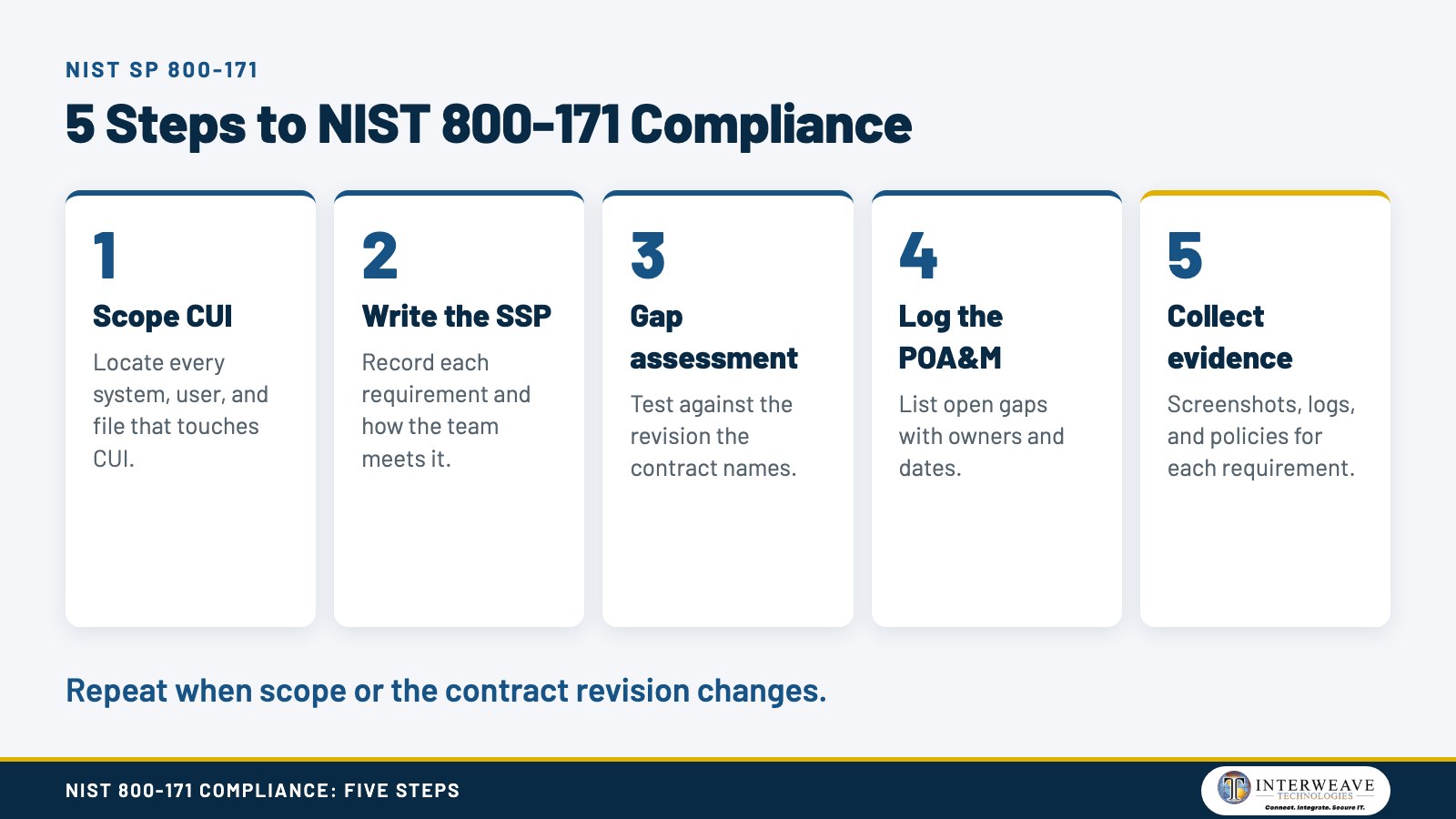
Start with scope to become NIST 800-171 compliant. Five steps cover the path from CUI scoping to evidence. A compliance advisor, attorney, or assessor can confirm the details for a specific contract. Contractors can also lean on contractor compliance program support for each step.
- Locate every system, user, and file that touches CUI.
- Write a System Security Plan (SSP) that records each requirement and how the team meets it.
- Run a gap assessment against the revision your contract names.
- Log open gaps in a Plan of Action and Milestones (POA&M) with owners and dates.
- Collect evidence such as screenshots, logs, and policies for each requirement.
Each step has its own guide. The SSP guide covers step two in detail. The steps repeat whenever scope or the contract revision changes.
The graphic below turns those steps into one checklist.
What Else Should You Know About NIST 800-171 and 800-53?
Is NIST 800-171 a Subset of NIST 800-53?
Yes, NIST 800-171 is a subset of 800-53 in content. NIST started from the moderate baseline and removed controls that do not protect CUI confidentiality. Some wording changed, so the two documents are not word-for-word copies.
Is NIST Required by Law?
NIST publications are guidance, and a law or contract makes them binding. FISMA drives federal agency use of SP 800-53. A contract clause such as DFARS 252.204-7012 drives contractor use of SP 800-171. Private firms without those clauses face no NIST mandate. A guide to other compliance rules lists further mandates.
What Is a NIST 800-171 Assessment?
A NIST 800-171 assessment checks each requirement against evidence. Teams run it as a self-assessment or, under CMMC Level 2, through a C3PAO. Assessors review the SSP, the POA&M, and evidence for each requirement.
Does NIST 800-171 Require FedRAMP?
No, NIST 800-171 does not require FedRAMP for your own network. DFARS 252.204-7012 sets a FedRAMP Moderate equivalent for external cloud providers that hold covered defense information. Check each cloud vendor against that clause.
Frequently Asked Questions
Does NIST 800-171 Replace NIST 800-53?
No, NIST 800-171 does not replace NIST 800-53. The two publications serve different audiences. Federal agencies keep using SP 800-53, and contractors that handle CUI use SP 800-171.
Can an Organization Follow Both Frameworks?
Yes, an organization can follow both. A cloud provider that serves agencies may need SP 800-53 controls, while its defense customers need SP 800-171. Mapping the shared controls once saves duplicate work.
Who Needs to Be NIST Compliant?
Federal agencies need SP 800-53 for their systems under federal law. Contractors that handle CUI need SP 800-171 through contract clauses. Companies with neither role have no NIST mandate, although many adopt the controls voluntarily.
What Is NIST 800-171 Compliance?
NIST 800-171 compliance means a contractor meets every requirement of the revision its contract names. The proof is an SSP, a POA&M for open gaps, and evidence for each requirement.
How Does Interweave Technologies Help Contractors Meet NIST 800-171 Requirements?
Interweave Technologies serves government contractors in North Alabama and the Southeast. Our team scopes CUI, builds the SSP and POA&M, and tracks evidence for NIST 800-171 requirements. Through ongoing compliance management, the work continues after the first assessment. We are not a C3PAO and do not certify anyone.
Technical controls need an owner too, including MFA, encryption, logging, and patching. Our security operations service runs those controls day to day for contractor networks.
Scoping comes first for any contract, because each requirement depends on where CUI lives and who handles it. The same scoping answers decide which systems an assessor reviews. A free scoping audit maps the gaps against a specific contract and its named revision.
Understanding NIST 800-171 vs 800-53 is the first step, and a call to (256) 837-2300 starts the second. Our team reviews each contract with the owner or IT manager before any work begins.
Teams that want the full service list can visit Interweave Technologies online.








Share Post