

Interweave Technologies

November 11, 2026

12 min
How Much Does Structured Cabling Cost for a Business?

Structured cabling costs about $150 to $300 per Cat6 drop in the United States, per a 2026 installer cost benchmark. A drop is one tested cable run. Cat6A runs $200 to $400 per drop, and standard fiber runs $300 to $800. A 20-drop Cat6 office totals roughly $3,000 to $6,000. Building pathway, local labor rates, and certification testing move the final number.
Key Takeaways
- A drop is one terminated, tested cable run, and its price bundles cable, connectors, testing, and labor.
- Cat6 runs $150 to $300 per drop, Cat6A runs $200 to $400, and standard interior fiber runs $300 to $800.
- Building access and pathway change the total more than the copper category does.
- Racks, switch setup, and a site survey add separate line items to a project quote.
- Local labor rates vary, so a written site survey is the only way to confirm a price.
How Much Does Structured Cabling Cost for a Business?
Structured cabling costs a business $150 to $300 per Cat6 drop in 2026, which is $3,000 to $6,000 for a 20-drop office. A 2026 installer cost benchmark lists Cat6A at $200 to $400 per drop. The same benchmark lists standard interior fiber at $300 to $800 per drop.
These figures are planning ranges, not quotes. Local costs vary with the building, the labor market, and the scope. A cabling quote from a site survey turns a range into a fixed number.
Per-drop pricing is the standard unit because it bundles every part of a working connection. That unit needs a clear definition before the table of prices.
What Does Structured Cabling Cost Per Drop by Cable Type?
Structured cabling cost per drop ranges from $150 for a basic Cat6 run to $1,000 or more for complex fiber. The table below shows 2026 installed costs by cable type, as listed in a 2026 installer cost benchmark reviewed in October 2026.
| Cable type | Installed cost per drop | Typical use |
|---|---|---|
| Cat6 copper | $150 to $300 | Standard workstation data drop |
| Cat6A copper | $200 to $400 | 10 Gbps to the 100-meter limit |
| Fiber, standard interior | $300 to $800 | Access point uplink or short backbone |
| Fiber, complex or exterior | $800 to $1,000+ | Long runs, conduit, building-to-building |
The table shows copper categories sitting close together in price. The benchmark explains that labor is identical across copper categories, while fiber runs two to three times a copper drop.
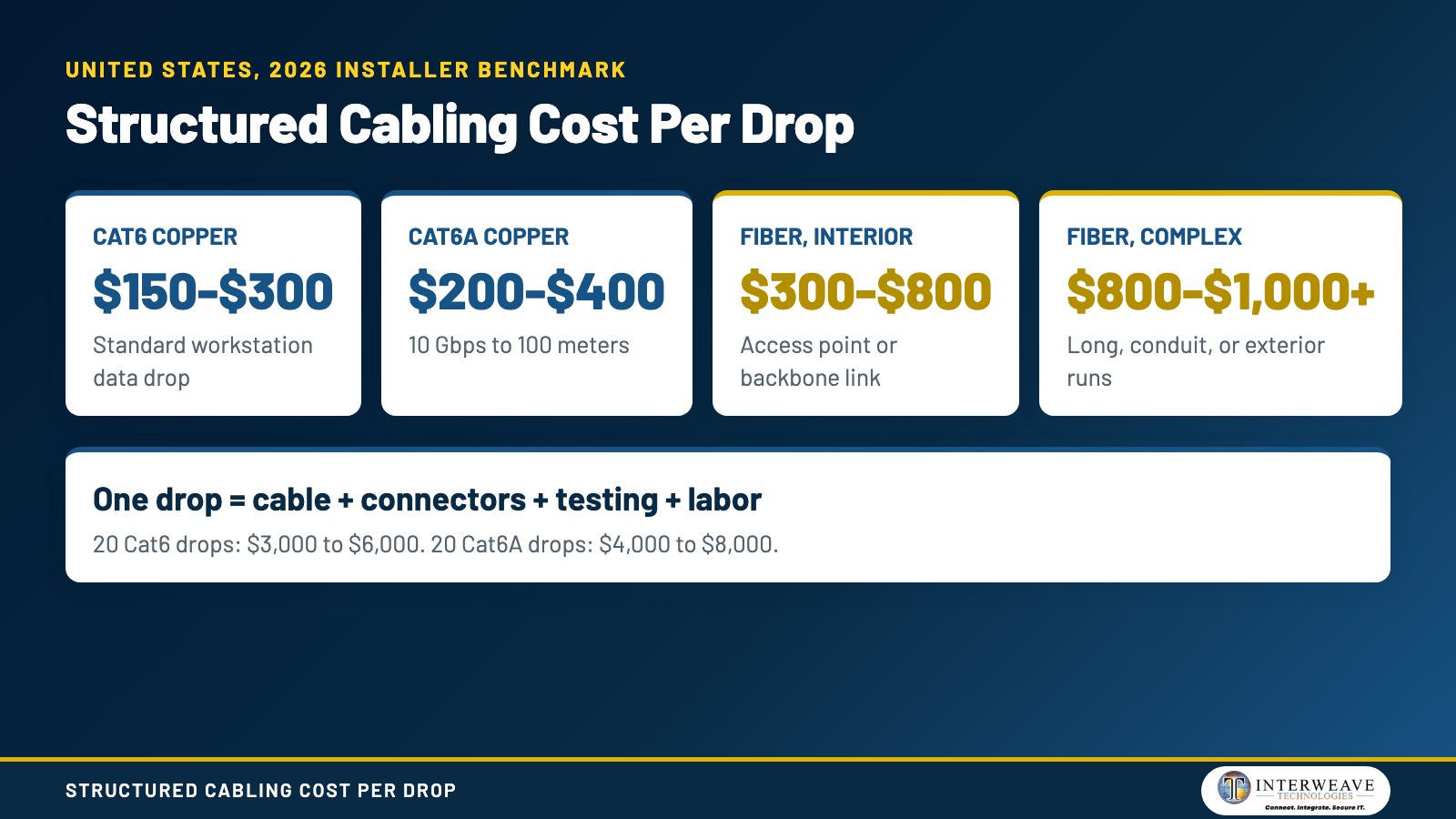
The graphic above charts the same four ranges. The next section defines the work behind those prices.
What Does the Term Structured Cabling Mean?
Structured cabling is a standardized system of copper and fiber cabling, hardware, and enclosures. It carries voice, data, and security traffic for one building or campus. The ANSI/TIA-568 standard defines its parts. Those parts are the entrance facility, equipment room, backbone cabling, telecommunications room, horizontal cabling, and work area.
The Telecommunications Industry Association (TIA) published the current revision, ANSI/TIA-568-E, in 2020. Each part has its own cable, jacks, and patch panels. A full office cable layout shows how those parts connect.
The standard also sets length limits that shape cost. Those limits appear in the section on Cat6 pricing.
What Is Structured Cabling Installation?
Structured cabling installation is the process of pulling, terminating, labeling, and testing cable runs. The runs go from a telecommunications room to each outlet, and the installer documents the result. A structured cabling installation covers the horizontal runs to desks, access points, phones, and cameras. It also covers the patch panels, racks, and backbone links that tie them together.
Businesses buy this work as structured cabling installation services from a low-voltage contractor. The contractor prices the job per drop or as a bundled project. The 2026 benchmark calls per-drop pricing the standard unit for scoping a build-out.
How Much Does Cat6 Installation Cost Per Drop?
Cat6 installation costs $150 to $300 per drop across the United States in 2026. A 2026 Boston-area installer price guide lists the same $150 to $300 range per outlet. That price includes cable, wall plate, termination, and testing.
The cat6 installation cost per drop stays near the Cat6A price because labor is the same. Cat6 is rated to 250 MHz, and Cat6A is rated to 500 MHz. For 10 Gbps, Cat6 reaches only 55 meters, while Cat6A reaches the full 100 meters.
A business that needs 10 Gbps at the full distance should price Cat6A. A business that only needs gigabit speeds can price Cat6. Readers weighing older cable can compare Cat5e versus Cat6 before budgeting.
What Factors Drive Structured Cabling Installation Cost?
Six factors drive structured cabling installation cost: cable category, run distance, pathway, conduit, labor rates, and drop count. The same 2026 benchmark names each one. Two buildings with the same drop count can land on very different totals.
- Cable category: copper categories cluster, and fiber costs two to three times a copper drop.
- Run distance: longer runs use more cable and labor, and copper stops at 100 meters.
- Pathway and access: an open tray or drop ceiling costs less than fishing cable through finished walls.
- Conduit: pulling through existing conduit is slower, and new conduit is its own line item.
- Labor market: after-hours and weekend work carry a premium.
- Drop count: forty drops in one visit price lower per drop than four visits of ten.
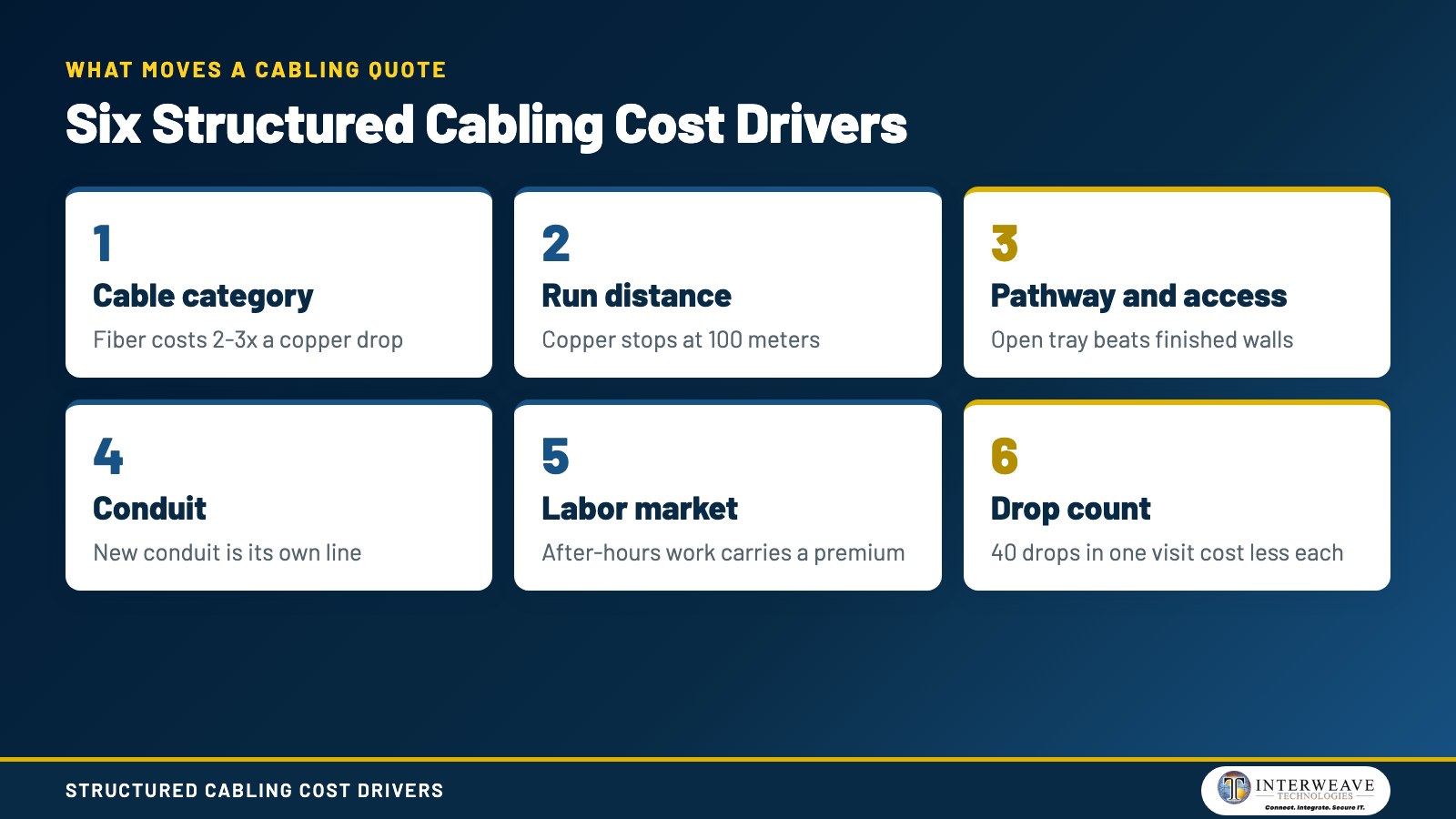
The graphic lists the same six drivers. Pathway is a swing factor in many quotes, and labor is the next factor to examine.
Why Do Labor Rates Change Data Cabling Installation Pricing?
Labor changes data cabling installation pricing because installers are skilled trades paid by local wage markets. The Bureau of Labor Statistics (BLS) reports a median annual wage of $63,190 for electricians in May 2025. The same agency reports $66,200 for telecommunications technicians.
BLS projects electrician employment to grow 9 percent from 2025 to 2035. Growing demand for skilled trades keeps labor a major part of any bid. A New Jersey cabling firm's budgeting guide calls labor typically the largest single line item in a cabling budget.
Wage levels differ by metro area, which is why a national range cannot replace a local quote. Project totals show how those costs add up.
How Much Does Structured Cabling Cost for a Small Office?
A small office pays about $4,000 to $8,000 for structured cabling. That job has 20 Cat6 drops, one rack with a patch panel, a managed switch setup, and testing. That total comes from a 2026 Boston-area installer price guide. The same guide lists $15,000 to $30,000 or more for a 60-drop, multi-floor office.
The table below compares those examples with the per-drop math from the 2026 installer benchmark.
| Project | Scope | Estimated total |
|---|---|---|
| 20 Cat6 drops | Open drop ceiling, business hours | $3,000 to $6,000 |
| 20 Cat6A drops | Open drop ceiling, business hours | $4,000 to $8,000 |
| Small office, 10 to 20 staff | 20 Cat6 drops, rack, patch panel, switch setup, testing | $4,000 to $8,000 |
| Larger office, 30 to 50 staff | 60 Cat6 drops, 4 to 6 fiber runs, multiple closets, access point cabling | $15,000 to $30,000+ |
The table shows that equipment and fiber raise a project above its drop math. The next section lists those extra items.
What Else Is in a Network Cabling Installation Quote?
A network cabling installation quote includes more than drops. The 2026 Boston-area guide lists a server rack installation at $800 to $2,500. It prices network switch setup at $400 to $1,200 and a site survey at $300 to $800. Each item appears as its own line.
Fiber is the other add-on. The same guide prices a fiber run at $500 to $1,500 or more, depending on termination type and distance. Ordering fiber installation for backbone links raises the total above a copper-only plan.
A quote that prices cable only and bills labor separately is not comparable to a per-drop bid. The 2026 benchmark calls that gap a common way a cheap-looking bid becomes a larger invoice.
How Does the Structured Cabling Installation Process Work?
The structured cabling installation process runs in four phases that take about three to ten days for a small office. The Boston-area guide lists the phases and their durations. Each phase ends with a deliverable.
- Site survey and planning, 1 to 2 days: walk the building, map routes, and produce a proposal with a cable map.
- Rough-in installation, 1 to 5 days: run cable through walls, ceilings, and conduit to each outlet.
- Termination and testing, 1 to 2 days: terminate, label both ends, certify each run, and write test reports.
- Cleanup and handoff, 1 day: remove debris, repair openings, and deliver documentation.
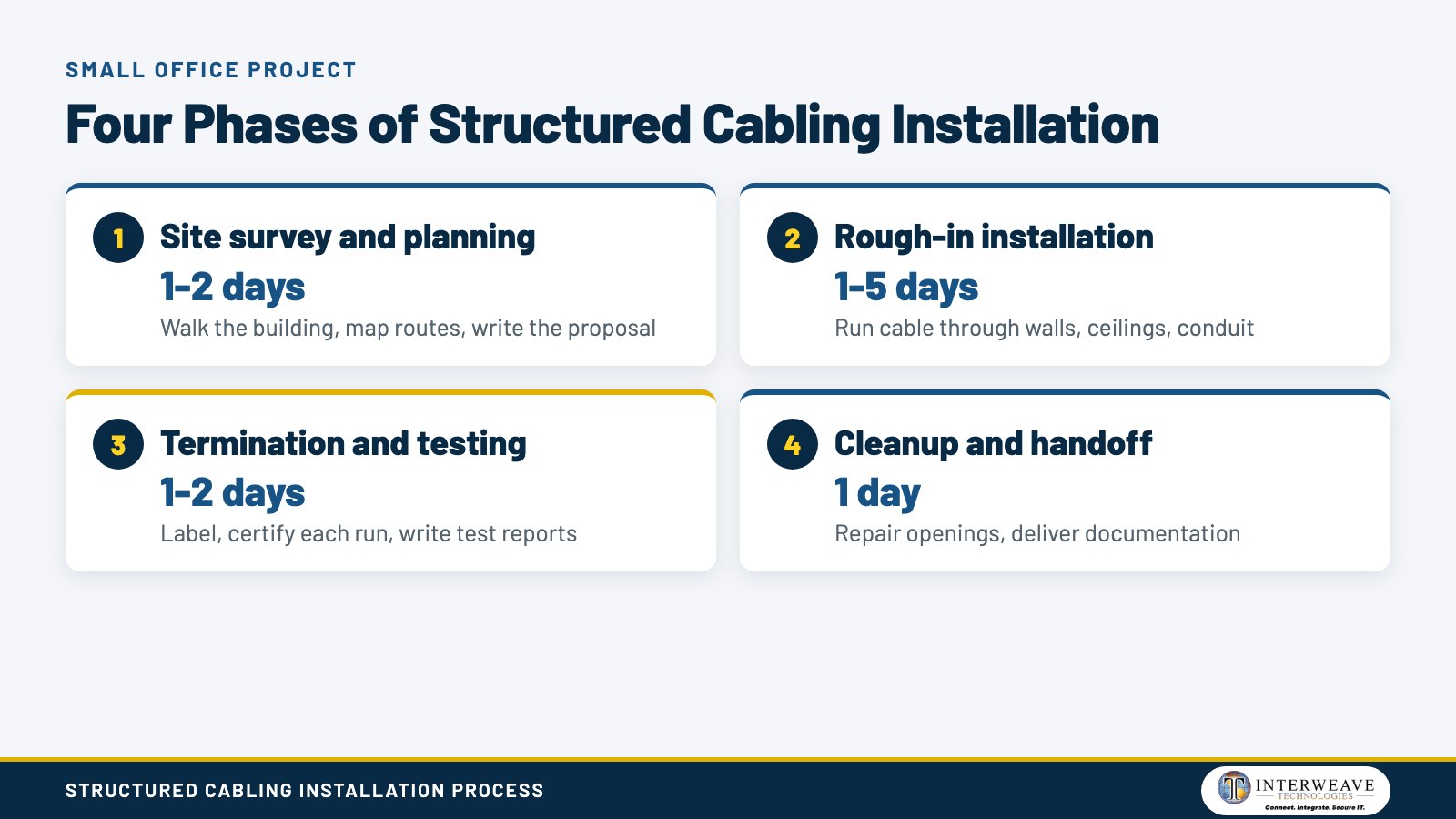
The graphic shows the same four phases and their day counts. Phase three carries a cost line of its own, because certification testing needs specialized equipment.
Do Permits and Equipment Add to Cabling Costs?
Yes, permits and equipment add to cabling costs, and both belong in the budget before work starts. A New Jersey cabling firm's guide says local codes govern low-voltage wiring. It adds that missed permits can delay a project and add fees. Equipment adds its own cost.
A 2026 budgeting guide from a cabling firm lists server racks, cabinets, cable management trays, and patch panels as hardware costs. It adds that mismatched or outdated hardware can create bottlenecks. Jacks and patch panels should match or exceed the cable category.
Switches and wireless access points are separate purchases from the cable itself. The cabling quote prices the runs and the rack, and the equipment list prices the devices that connect to them. Quotes become comparable once each contractor lists these items.
How Do You Compare Structured Cabling Installation Quotes?
Compare structured cabling installation quotes by giving every contractor the same scope. The scope needs one drop count, one cable category, one pathway assumption, and one testing standard. The 2026 benchmark says a bid that looks 20 percent cheaper per drop is usually missing one of those variables.
Ask each contractor to price the following items in writing.
- The exact drop count, split by cable category.
- The pathway: open tray, existing conduit, or finished walls.
- The testing and certification standard for every drop.
- The schedule: business hours versus after-hours access.
- Racks, patch panels, labeling, and documentation.
A site survey backs those answers with facts. Teams that want a written estimate can request a cabling site survey before approving a budget.
Once the quotes match in scope, the budget needs a buffer. That buffer is the next topic.
How Much Contingency Should a Cabling Budget Include?
A cabling budget should include a contingency of 10 to 15 percent of the total project cost. A New Jersey cabling firm's budgeting guide gives that range. The buffer covers change orders and hidden conditions found after walls open.
Older buildings raise the odds of surprises. The same guide notes that older commercial buildings may have outdated conduit or asbestos-lined walls. A written scope of work cuts change orders further.
Buffers protect a budget, and smart planning can shrink the base cost. The next section covers those savings.
How Can a Business Lower Structured Cabling Costs?
A business lowers structured cabling costs by batching drops into one visit and choosing easy pathways. The 2026 benchmark says forty drops in one trip price lower per drop than four trips of ten. Open-wall pre-wiring during construction also reduces labor.
Planning the whole building at once avoids repeat mobilization fees. Teams planning hybrid offices can read about hybrid office cabling before they count drops. Drop counts should include desks, printers, phones, and cameras.
Cable choice matters least for saving money, since copper categories cluster in price. Fiber is the larger step up, which leads to the length limits behind that choice.
How Long Can a Cabling Run Be Before Costs Change?
A copper cabling run can be 100 meters in total before costs change, because longer runs need fiber or another telecommunications room. The ANSI/TIA-568 standard sets horizontal cable at a maximum of 90 meters, with 100 meters total including patch cords. No patch cord should exceed 5 meters.
The table below compares the two copper categories at 10 Gbps.
| Category | Frequency rating | 10GBASE-T maximum length |
|---|---|---|
| Cat6 | 250 MHz | 55 meters |
| Cat6A | 500 MHz | 100 meters |
The table shows why long 10 Gbps runs call for Cat6A. Runs past 100 meters move to fiber, which carries the higher price per drop shown earlier.
What Else Should You Know About Structured Cabling Costs?
What Are the Four Types of Network Cables?
Four cable types serve small business networks: Cat6, Cat6A, fiber optic, and coaxial. Cat6 and Cat6A are twisted-pair copper for desks and access points. Fiber carries backbone and long-distance links. Coaxial supports older video and cable internet runs. Wireless gear needs access point drops on copper or fiber.
What Is a Structured Cabling Installer?
A structured cabling installer is a trained technician who runs, terminates, and tests low-voltage cable for voice, data, and security systems. Many installers hold electrician or telecommunications credentials. BLS counts telecommunications technicians as a separate occupation with a $66,200 median wage.
Does Network Infrastructure Planning Change the Cabling Budget?
Yes, network infrastructure planning changes the cabling budget because switches, racks, and wireless coverage set the drop count. Reviewing network infrastructure basics first prevents rework. Each added device type adds drops.
Do Phones and Cameras Need Their Own Drops?
Yes, desk phones and cameras each need one drop when they use wired connections. Teams adding camera cabling should count each camera in the drop total. Phone systems follow the same rule.
Where Do Other Cabling Services Fit?
Fiber, voice, and security wiring sit beside office data drops in the same project. Each service has its own drop count and price range. One survey with a team that offers cabling services can scope all of them together.
Frequently Asked Questions
What Counts as One Drop in a Cabling Quote?
One drop is a single cable run from a network closet or patch panel to one endpoint. It is terminated at both ends and tested. The endpoint can be a workstation, wireless access point, printer, or camera. The price bundles cable, connectors, testing, and labor.
How Much More Does Fiber Cost Than Copper?
Fiber costs two to three times a copper drop, according to a 2026 installer benchmark. Standard interior fiber runs $300 to $800 per drop, against $150 to $300 for Cat6. A Boston-area guide lists fiber at $500 to $1,500 or more per run.
Does Certification Testing Add Cost?
Yes, certification testing adds cost, and quotes should list it. Testing uses specialized equipment to verify signal loss and crosstalk on every run. A cabling budgeting guide warns that skipping it can lead to intermittent network problems.
Are These Prices Quotes From Every Provider?
No, these prices are planning ranges from 2026 installer guides, not quotes. Costs vary by city, building, and scope. A written site survey gives the only price a business can rely on.
How Long Does a Small Office Cabling Project Take?
A small office cabling project takes about 3 to 10 days across four phases, per a 2026 Boston-area guide. Survey and planning take 1 to 2 days. Rough-in takes 1 to 5 days, termination and testing take 1 to 2 days, and cleanup takes 1 day.
What Does Cat6A Add Beyond Cat6?
Cat6A adds a 500 MHz rating and a full 100-meter reach for 10 Gbps, while Cat6 reaches 55 meters at that speed. Cat6A drops cost $200 to $400, against $150 to $300 for Cat6. The extra cost buys longer high-speed runs.
How Does Interweave Technologies Help Businesses Plan Structured Cabling?
Interweave Technologies plans and installs structured cabling and fiber optics for businesses in North Alabama and the Southeast. The team surveys the building, counts drops, maps pathways, and writes a scope that makes quotes comparable. Testing and documentation come with the install.
Teams that also plan new desk phones can add phone system upgrades to the same survey, so voice drops are counted once. Camera, access point, and printer drops join the same count.
The answer to how much does structured cabling cost starts with that survey. Businesses can reach Interweave Technologies at (256) 837-2300 to schedule one.






Share Post