

Interweave Technologies

November 22, 2026

12 min
What Are the DFARS 252.204-7012 Incident Reporting Requirements?

The DFARS 7012 reporting requirements give a defense contractor 72 hours from discovery to report a cyber incident involving covered defense information. The report needs a DoD-approved medium assurance certificate. The contractor must also keep images of affected systems for at least 90 days. Subcontractors follow the same clause, and as of November 2026 reports go through the DC3 incident collection portal.
Key Takeaways
- The clock is 72 hours from discovery of a cyber incident, not from the end of the investigation.
- A DoD-approved medium assurance certificate is required to file, so obtain it before an incident happens.
- Affected system images and packet capture data must be kept at least 90 days after the report.
- Malware goes to the DoD Cyber Crime Center (DC3), never to the Contracting Officer.
- Primes must flow the clause down, and subcontractors must pass the DoD incident report number up.
What Are the Reporting Requirements for DFARS 252.204-7012?
The reporting requirements for DFARS 252.204-7012 start with a report to DoD within 72 hours of discovery. A compromise review and a medium assurance certificate support that report. The clause adds malware submission, 90-day media preservation, forensic access, and flow-down to subcontractors. Each duty sits in paragraphs (c) through (m) of the clause.
The Department of Defense (DoD) clause is titled Safeguarding Covered Defense Information and Cyber Incident Reporting. The DFARS 7012 reporting requirements apply on every contract that carries the clause. A managed provider with DFARS readiness can map each duty to a named owner before the first alert.
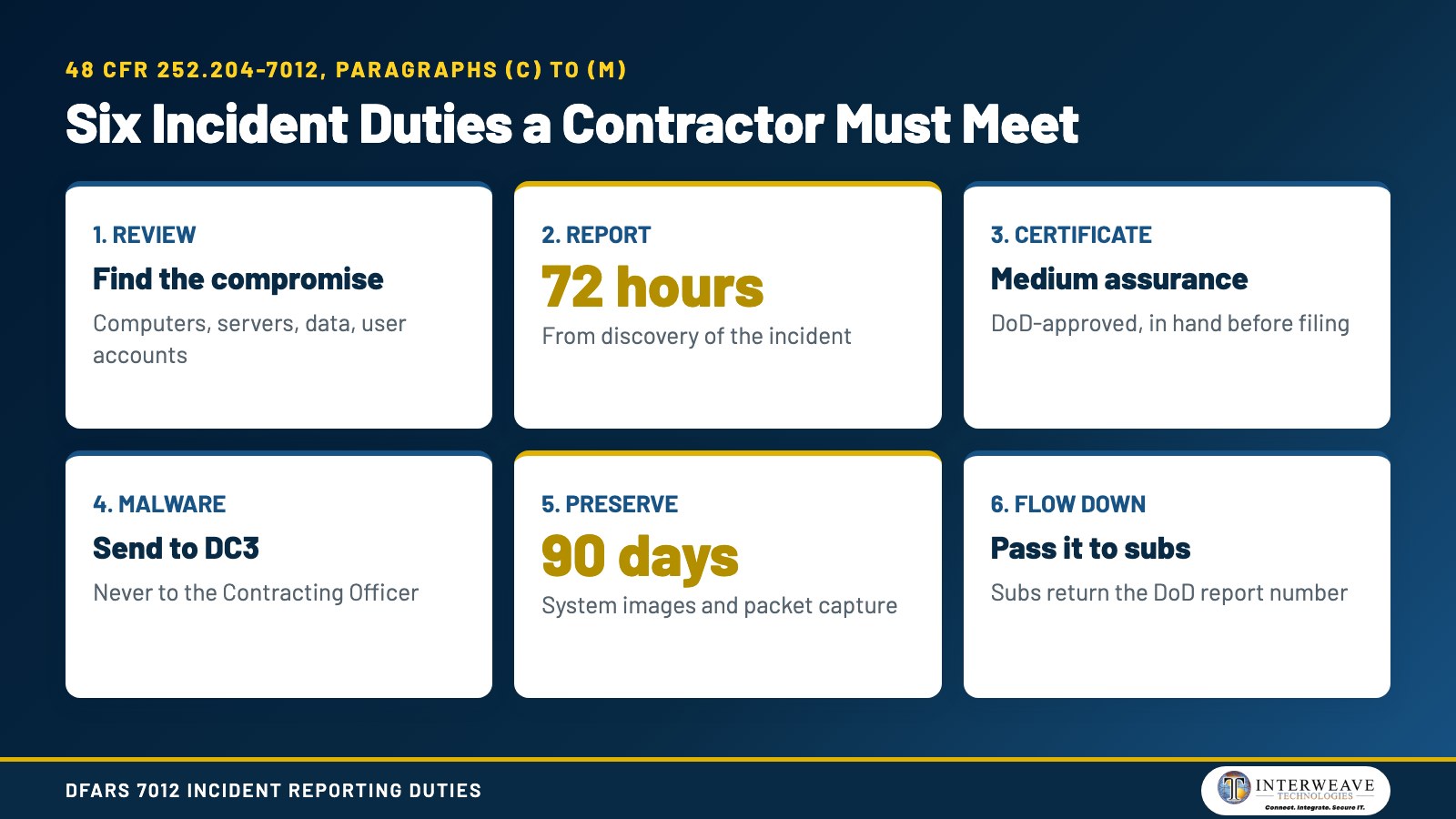
The graphic above lists the six duties in the order a contractor meets them. The next section defines the clause itself and who must follow it.
What Is DFARS 7012 and Who Must Follow It?
What is DFARS 7012 in plain terms: a DoD contract clause that protects unclassified covered defense information and requires cyber incident reporting. The full clause text is 48 CFR 252.204-7012, dated MAY 2024 in the current Code of Federal Regulations. Contractors must follow it whenever the clause appears in a contract.
Covered defense information (CDI) is unclassified controlled technical information or other controlled unclassified information (CUI). It is either marked in the contract or collected, developed, received, or stored in support of the contract. Any contractor system that processes, stores, or transmits CDI is a covered contractor information system.
The clause also reaches subcontractors that handle CDI. Practical guidance on contractor cybersecurity rules shows how the clause fits beside other federal obligations. The next question is which events trigger a report.
What Cyber Incident Must Be Reported Under DFARS 7012?
A reportable cyber incident is any event that affects a covered system, its CDI, or operationally critical support. The clause defines a cyber incident as network actions that compromise a system or have a potential or actual adverse effect.
The word "potential" matters. The definition of compromise covers unauthorized disclosure, modification, destruction, or loss of information, or a violation of a system security policy. Operationally critical support means services the Government designates as essential to moving and sustaining the Armed Forces in a contingency operation.
Detection tools make the discovery moment clear. A security information and event management (SIEM) platform with SIEM logging stamps each alert with a time. That timestamp starts the clock described next.
When Does the 72 Hour Cyber Incident Reporting DoD Clock Start?
The 72 hour cyber incident reporting DoD clock starts at discovery, not at confirmation. The clause defines rapidly report as within 72 hours of discovery of any cyber incident. Paragraph (c)(1)(i) also requires a review for evidence of compromise as soon as the contractor discovers the incident.
That review must identify compromised computers, servers, specific data, and user accounts. It must also cover other systems on the contractor's network that the incident may have reached. A contractor therefore reviews and reports in parallel, not in sequence.
The table below lists each duty, its clause paragraph, and its timing or trigger, as written in the clause.
| Duty | Paragraph | Timing or trigger |
|---|---|---|
| Review for evidence of compromise | (c)(1)(i) | On discovery of the incident |
| Report to DoD | (c)(1)(ii) | Within 72 hours of discovery |
| Hold a medium assurance certificate | (c)(3) | Have or acquire before reporting |
| Submit malicious software to DC3 | (d) | Per DC3 or Contracting Officer instructions |
| Preserve images and packet capture | (e) | At least 90 days from report submission |
| Give forensic access | (f) | When DoD requests it |
| Provide damage assessment information | (g) | When the Contracting Officer requests it |
Two rows depend on a DoD request, so they cannot be scheduled in advance. The reporting channel itself changed in 2025, which the next section covers.
How Do You Submit a DIBNet Incident Report Today?
Submit a DIBNet incident report today through the DC3 Incident Collection Format (ICF) portal. Peerless Tech Solutions and ISI Defense both report that DoD decommissioned the old DIBNet portal on June 6, 2025. The old link now redirects to the DC3 DIB Cybersecurity site.
The clause text in the Code of Federal Regulations still names dibnet.dod.mil. Confirm the current channel with the Contracting Officer or DC3 before an incident. The sequence reported by those two sources has four steps.
- Open the ICF portal from the DC3 DIB Cybersecurity page and sign in with a DoD-approved medium assurance certificate.
- Complete the ICF form with the same incident details the old process collected.
- Download the generated ICF XML file and the submission instructions.
- Send the XML file to DC3 by encrypted email or DoD SAFE (Secure Access File Exchange). Keep the incident number DC3 returns.
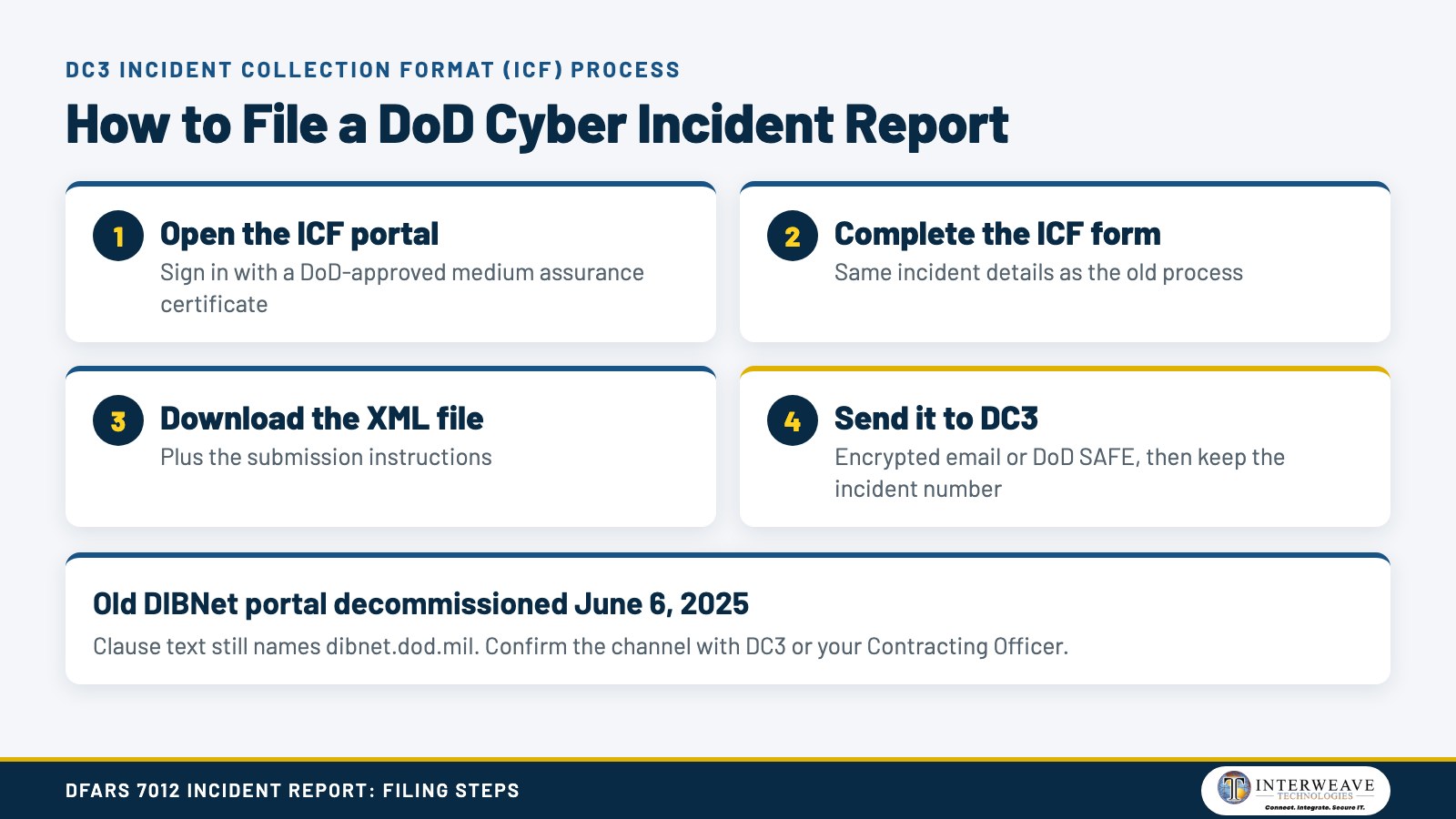
The graphic shows the four filing steps and the incident number returned at the end. That number matters for subcontractors, covered in a later section. The certificate is the one item that cannot be rushed.
How Do You Get a DoD-Approved Medium Assurance Certificate?
Get a DoD-approved medium assurance certificate through the External Certificate Authority (ECA) information at public.cyber.mil/eca. Paragraph (c)(3) cites that page and says the contractor or subcontractor shall have or acquire the certificate.
A Common Access Card (CAC) or an ECA certificate also opens the ICF portal, according to Peerless Tech Solutions. Contractors without a certificate are told to contact DC3 directly. Obtaining the certificate before an incident removes that dependency from the 72-hour window.
A written plan names who holds the certificate and who covers when that person is away. Teams that manage government contract cybersecurity keep that assignment in the incident response plan. Once a report is filed, a separate set of preservation duties begins.
What Must You Preserve After a Cyber Incident?
After a cyber incident, a contractor must preserve images of affected systems and packet capture data for at least 90 days. Paragraph (e) counts the 90 days from report submission and gives DoD time to request the media or decline interest.
Preservation covers the systems identified in the compromise review. A contractor keeps these items in a protected location:
- Forensic images of each affected server, workstation, and virtual machine.
- Network monitoring and packet capture data tied to the incident.
- Logs and the review notes that identified compromised accounts and data.
Upon DoD request, the contractor must also give access to additional information or equipment needed for forensic analysis. When DoD runs a damage assessment, the Contracting Officer asks for the information gathered under paragraph (e). Malware follows its own rule within the DFARS 7012 reporting requirements.
What Should You Do With Malicious Software Found in an Incident?
Submit malicious software to the DoD Cyber Crime Center (DC3) in accordance with DC3 or Contracting Officer instructions. Paragraph (d) states the contractor must not send the malicious software to the Contracting Officer. The rule applies when a contractor or subcontractor discovers and isolates malware in connection with a reported incident.
Endpoint tools help here. EDR monitoring captures process activity and file samples on laptops and servers. Those records support both the review and the malware handoff. Primes and their suppliers share these duties.
What Do Subcontractors and Cloud Providers Owe the Prime Contractor?
Subcontractors that handle CDI follow the same clause and give the prime the DoD-assigned incident report number as soon as practicable. Paragraph (m) requires the prime to include the clause without alteration in subcontracts involving CDI, including subcontracts for commercial products or services.
The prime decides whether the information a subcontractor receives keeps its identity as CDI. A subcontractor also notifies the prime when it asks the Contracting Officer to vary from a NIST SP 800-171 requirement. These duties make who needs CMMC a flow-down question as well.
Cloud providers carry a parallel duty. An external cloud service provider that stores, processes, or transmits CDI must meet security requirements equivalent to the FedRAMP Moderate baseline. The provider must also comply with paragraphs (c) through (g) on reporting, malware, preservation, and forensic access. An explanation of the FedRAMP Moderate baseline helps when you question a cloud vendor.
What Are DFARS Requirements Beyond Incident Reporting?
DFARS requirements for covered contractors include implementing NIST SP 800-171 under 7012 and keeping a current assessment under 7019, 7020, and 7021. The clause family adds scoring, DoD access, and CMMC status duties on top of the reporting rules described above.
The table compares the four clauses by what each requires and the key number in its text.
| Clause | What it requires | Key number |
|---|---|---|
| 252.204-7012 | NIST SP 800-171 and cyber incident reporting | 72 hours to report, 90 days to preserve |
| 252.204-7019 | A current NIST SP 800-171 assessment posted in SPRS | Not more than 3 years old |
| 252.204-7020 | Government access for Medium and High Assessments, and subcontractor assessments | Sub needs a Basic Assessment within 3 years |
| 252.204-7021 | CMMC status at the level the contract requires | Final Level 2 status not older than 3 years |
The Supplier Performance Risk System (SPRS) holds the summary score. A Basic Assessment is a contractor self-assessment with a Low confidence level. The DFARS 7012 requirements for adequate security rest on NIST SP 800-171 Rev 2, which has fourteen families. The 7019 and 7020 clauses report that implementation as a score out of 110.

The graphic repeats the four clauses and their timing figures. Gaps in a score belong in a plan of action, which DoD reads alongside the system security plan. The broader rule set for contractors comes next.
What Are the Cybersecurity Requirements for Government Contractors?
The cybersecurity requirements for government contractors are NIST SP 800-171, incident reporting, an SPRS assessment, and CMMC status. DFARS 252.204-7012 supplies the first two. DFARS 252.204-7019 through 7021 supply the assessment and CMMC duties.
NIST SP 800-171 Rev 2 organizes its requirements into fourteen families. Incident Response is one family, and it feeds directly into how a contractor handles the 72-hour report. The CMMC program adds third-party verification for contracts that require it. The clause that ties CMMC to a contract is the subject of the next section.
Which DFARS Clause Requires CMMC?
DFARS 252.204-7021 requires CMMC. The NOV 2025 version requires a current CMMC certificate or status at the level the contract sets. Clause 7012 stays in force beside it.
The DFARS acquisition rule took effect November 10, 2025. Under 32 CFR 170.3, Phase 1 began on that date. Phase 2 was planned for November 10, 2026. The Department of War suspended it on July 13, 2026, per Crowell & Moring.
The Federal Register states that CMMC is separate from the cyber incident reporting requirements of 7012. A contractor must therefore keep reporting duties current with a CMMC status in place. A Final Level 2 status must be not older than 3 years, and the CMMC status date anchors that count.
How Do DFARS 7012 Requirements Shape Your Incident Response Plan?
DFARS 7012 requirements shape an incident response plan with a 72-hour deadline, a certificate holder, and evidence preservation. NIST SP 800-171 Rev 2 requirement 3.6.1 calls for an operational incident-handling capability covering preparation, detection, analysis, containment, recovery, and user response.
Requirement 3.6.2 says to track, document, and report incidents to designated officials and authorities. Requirement 3.6.3 says to test the organizational incident response capability. A tabletop exercise that times the 72-hour report tests all three at once.
Business-wide incident response planning supplies the base steps. Contractors then add the DoD-specific items: certificate holder, ICF filing path, image retention, and a subcontractor notice template. The system security plan should describe the same process in writing.
What Else Should You Know About DFARS 7012 Reporting?
Does CMMC Replace the DFARS 7012 Report?
No. The Federal Register states that CMMC is an assessment framework and is separate from the 7012 cyber incident reporting requirements. A contractor with a CMMC status still reports qualifying incidents within 72 hours.
Who Sees the Information in an Incident Report?
DoD treats the report as information created by or for DoD. Paragraphs (h) through (j) say the Government protects contractor attributional and proprietary information. Authorized releases go to entities such as those that diagnose or mitigate incidents and to law enforcement. Mark proprietary data in the report.
Does a 7012 Report Replace Other Reporting Duties?
No. Paragraph (l) says the clause does not replace other safeguarding or incident reporting required by other contract clauses or federal law. A contractor therefore checks each contract and regulation for separate notice duties.
What Does a DFARS 7012 Report Contain?
A DFARS 7012 report contains, at a minimum, the required elements listed on the DoD reporting site. Paragraph (c)(2) sets that floor. Gather system names, timing, affected accounts, and a short narrative before opening the ICF form.
Is a Cloud Provider Responsible for Filing the Report?
No. The contractor whose contract carries the clause files the report. The cloud provider must still meet FedRAMP Moderate equivalent security. It must also comply with paragraphs (c) through (g).
What Does a Data Breach Cost?
IBM's 2025 Cost of a Data Breach report puts the global average breach at USD 4.44 million. IBM lists the U.S. average at $10.22 million. Reporting speed and preserved evidence affect how quickly a contractor contains the loss.
Frequently Asked Questions
Who Does DFARS Apply To?
DFARS applies to contractors whose DoD contracts include the clause, and the clause flows down to subcontractors that handle covered defense information. The contract text and the Contracting Officer confirm which clauses apply.
Does the DoD Use NIST?
Yes. Clause 7012 requires covered systems to meet the NIST SP 800-171 version in effect at solicitation. The Contracting Officer may authorize a different version.
What Is Operationally Critical Support?
Operationally critical support means supplies or services the Government designates as critical for airlift, sealift, intermodal transportation, or logistical support. Those services must be essential to mobilizing, deploying, or sustaining the Armed Forces in a contingency operation.
When Does CMMC Phase 2 Begin?
No new Phase 2 date exists as of November 2026. Phase 2 was planned for November 10, 2026, one year after Phase 1 began. The Department of War suspended it on July 13, 2026, for a 60-day reform review, per a Crowell & Moring client alert. Phase 1 self-assessments and DFARS 252.204-7012 stay in force. Skadden and McGuireWoods report the same suspension.
What Does a Subcontractor Send to the Prime After an Incident?
A subcontractor sends the DoD-assigned incident report number to the prime contractor, or the next higher-tier subcontractor, as soon as practicable. Paragraph (m)(2)(ii) of the clause sets this duty.
How Does Interweave Technologies Help Contractors Prepare for DFARS 7012 Reporting?
Preparing for the DFARS 7012 reporting requirements means assigning every duty to a named person and tool. Interweave Technologies helps government contractors in North Alabama and across the Southeast turn the clause into a working incident process. We map the 72-hour steps, the certificate holder, and the 90-day evidence plan to named people and tools.
Our team runs monitoring, logging, and endpoint protection that produce the timestamps and images the clause requires. We also support NIST SP 800-171 documentation as part of a managed compliance program. A free risk scoping conversation starts the review. Talk to your compliance advisor, attorney, or assessor about contract-specific questions, and call (256) 837-2300 to begin.








Share Post